
St. Donatus Prairie Settlement, Sioux County, Iowa
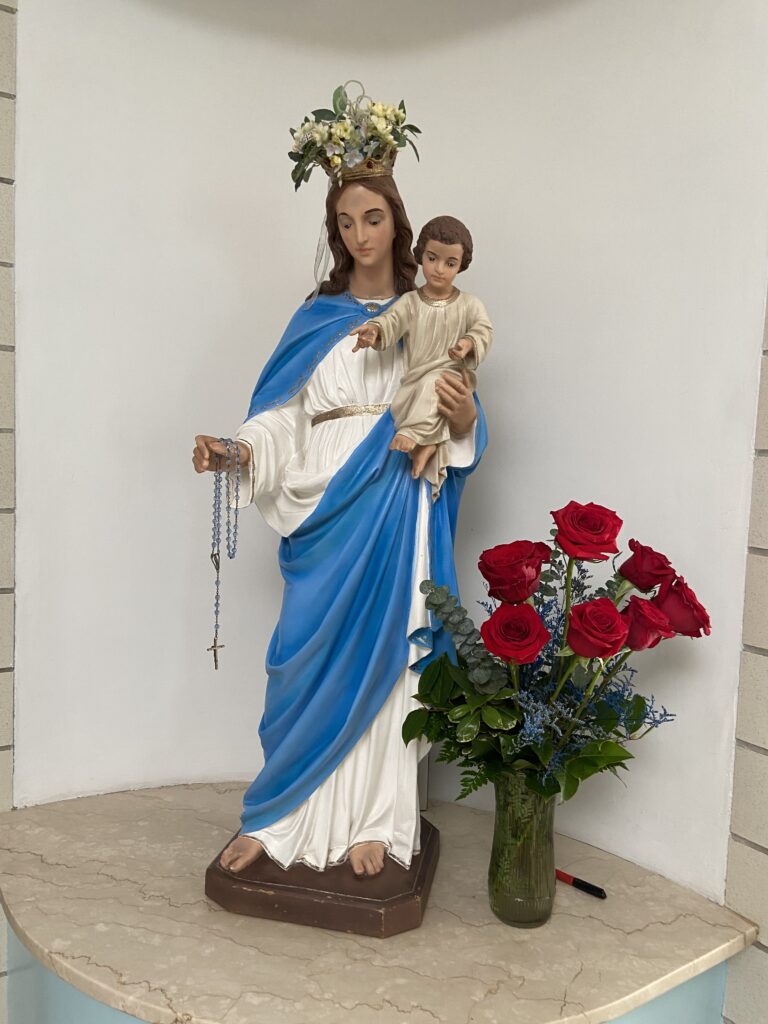
The presence of Luxembourgers in northwest Iowa dates to May 1870 when 38 Luxembourg settlers left St. Donatus, Dubuque County, in northeast Iowa and traveled west across the prairies of Iowa with their ox-drawn wagons. As a sign of their faith, they brought along a statue of the Blessed Virgin Mary, now housed in St. Mary Parish Center in Alton, Iowa.
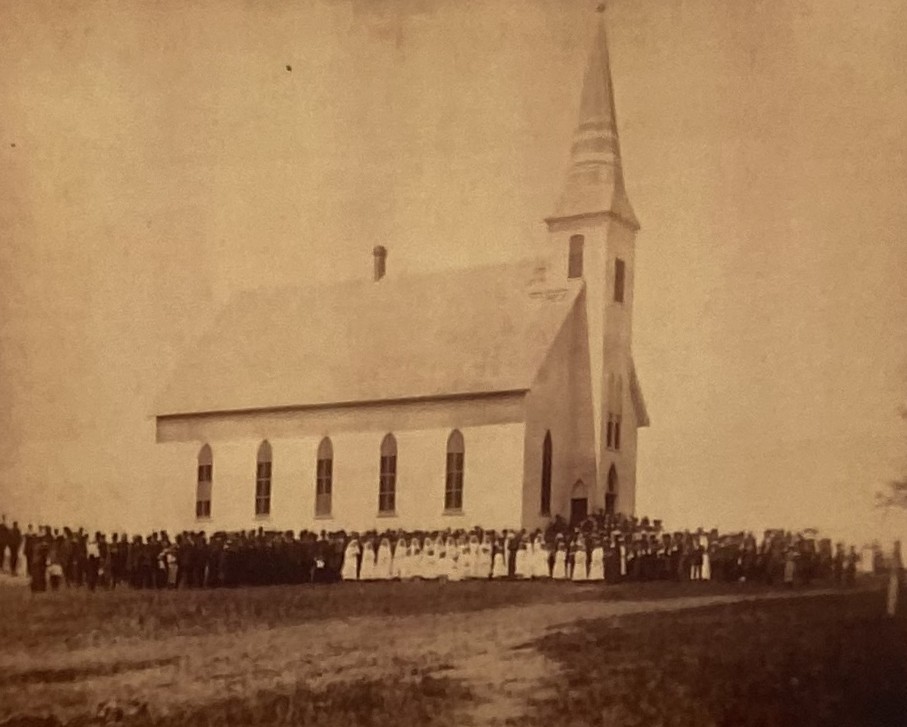
These first Luxembourgish pioneers settled in an area in Sioux County about two miles southeast of present-day Alton, Iowa, and established farms, some building sod houses. They depended on itinerant priests for their religious needs and traveled about 20 miles by wagon to Le Mars, Iowa, for Christmas Mass, leaving at midnight to make it on time. In 1881, the settlers began building their own church on the southwest corner of Section 18 of East Orange Township, the current intersection of Kingbird Avenue and 480th Street. Matt Probst donated eight acres of land for the new church, and each parishioner was assessed up to $80 to help pay for materials.
In May 1881, a windstorm struck the area and destroyed the nearly completed church. The congregation immediately started rebuilding the church, which they named in honor of St. Donatus and dedicated on September 12, 1881.
St. Donatus prairie church was used until the end of 1896 when it was dismantled. The materials were used to enlarge the nearby St. Mary’s Church in Alton (originally called East Orange), also founded by Luxembourgers. The railroad had been built in 1871 to pass through Alton, which led to the demise of the St. Donatus prairie site. Graves from the St. Donatus cemetery were moved to St. Mary’s Cemetery in Alton except for a few that contained bodies of those who had died from communicable diseases. Those graves are now under the surrounding farm fields.
Celebrating the 40th anniversary
In 1910, the Alton community celebrated the 40th anniversary of the first Luxembourg settlers in northwest Iowa. The “Luxemburger Gazette,” Dubuque, Iowa, May 31, 1910, reported:
Alton, Sioux County, Iowa (Special Correspondence)
A particularly beautiful celebration took place on May 18, in the local St. Mary’s Church. Exactly 40 years ago, on May 19, 1870, the first Catholic pioneers came to Sioux County. In the first days of the month of May, 18 ox-drawn covered wagons, so called “prairie schooners,” undertook the 300-mile-long trek from the banks of the Mississippi to northwest Iowa. Only someone who has done a similar voyage can imagine the difficulties of such a trip, which went over mountains and valleys, swallowing rivers and swampy plains. Very often the heavy wagons got stuck in the soggy ground and many a time the tired wanderers longed to be back on the banks of the Mississippi. Finally, on May 19, after indescribable hardships, they arrived in Sioux County
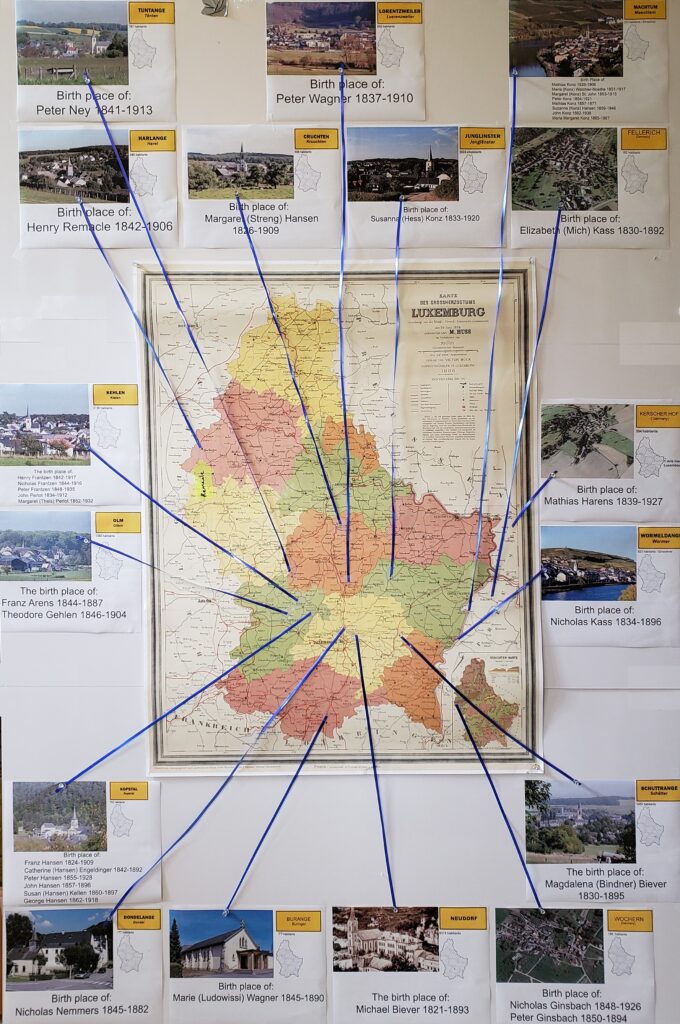
Far and wide no human dwelling was to be seen, only the wide, wild, barren prairie. They were just 40 pioneers, strangely all Luxembourgers, as the following names will show: Franz Arens, Michale Biever and wife Magdalena (Bindner) and sons John, Peter and Jean; Peter, Nicolaus and Heinrich Frantzen; Nicolaus and Peter Ginsbach; Theodor Gehlen; Franz Hansen and wife Margaretha (Streng) together with their children Peter, John Catharina, Susanna, Margaretha and Georg; Math Harens; Nicolaus Kass; Math. Konz and wife Susanna (Hess) with children Peter, Math, John, Margareth Susanna, Jacob, Nicolaus and Peter M.; Nicolaus Nemmers; Peter Ney; Peter Perlot and wife (Margaret Theis); Heinrich Remacle, Peter Wagner and wife Maria (Ludovicy) with daughter Theresia.
Of the enumerated only 22 live still today, as 18 of them have died. In the following years other pioneers joined them and thus the thriving colonies came into existence in Plymouth and Sioux Counties: Le Mars, Alton, Remsen, Hospers, Granville, Oyens. Although the first settlers and their descendants possessed little more than their strong arms, they had courage, trust in God and a deeply religious mind. They prayed the rosary on the open prairie and sang the pious hymns they had brought with them from their homeland. And so God blessed their hard work. Where, 40 years ago, there was wild prairie and the bleached bones of deer and some other animals, there are now the most beautiful farms. Many a pioneer left again, so hard was the first pioneer life in northwestern Iowa; probably all would have left had they only had the means.
No wonder then, that the old-timers was to commemorate the day “when cross and rosary were brought to Sioux County” as the Rev. pastor said in his homily. No wonder they and their children and their friends want to assemble in the house of God to thank the Giver of all good things and to thank Him for future protection and blessing. Not only the old pioneers but the entire community hastened to the splendid church to attend the thanksgiving Mass. Also from the neighboring communities joyful visitors and pious worshippers had arrived.
Fr. Brune delivered the appropriate sermon. He pointed out the sacrifices and hardships of the old settlers and their courage and trust in God. More particularly, their strong faith that 40 years ago brought “the cross and rosary to this formerly barren and now blessed area.”
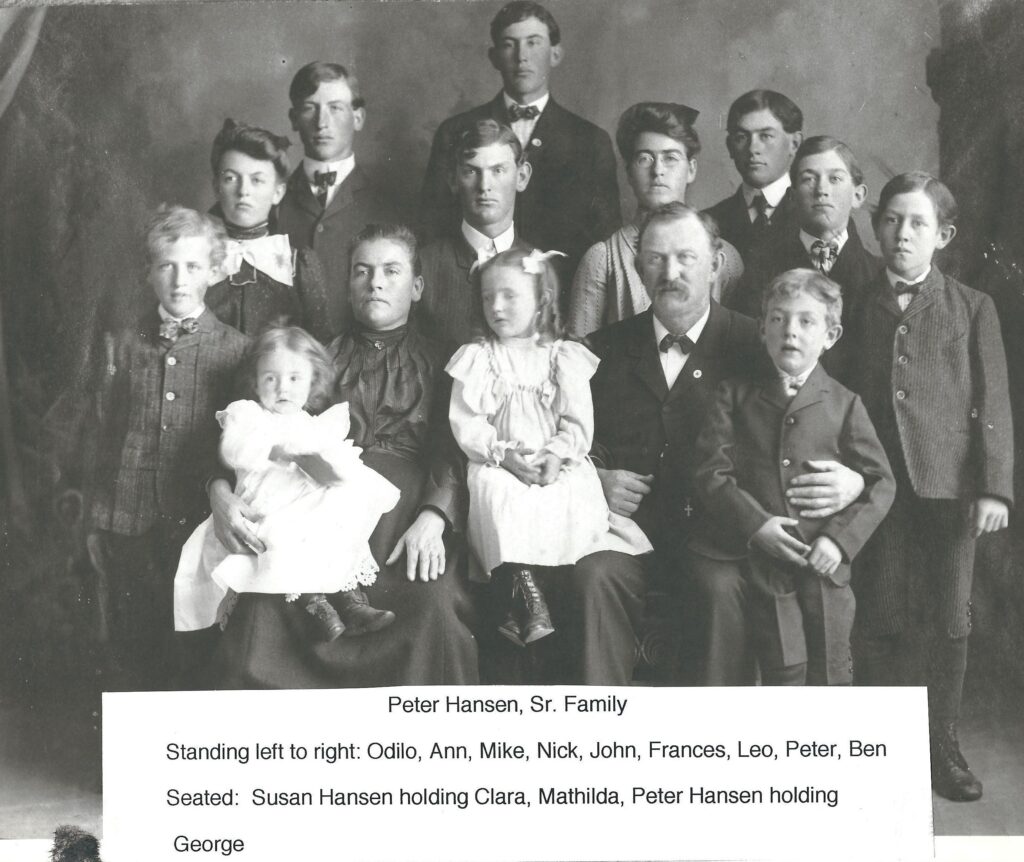
In the afternoon the pioneers and their friends conversed at the hospitable home of Mr. Peter Hansen. Memories of former times were refreshed, some of them of funny and comical stories. In the evening, the St. Mary’s Men’s Choir showed up and entertained those present with many beautiful songs.
Next morning, on Friday, a High Mass was held for the deceased pioneers, and a large group of parishioners attended the service. May it be granted to those living settlers, to celebrate in 10 years the golden jubilee when “cross and rosary were brought to Sioux County.”
F. J. B. (Fr. Frederick J. Brune – 1856-1928, pastor of St. Mary’s Church in Alton)
Commemorating 50 years
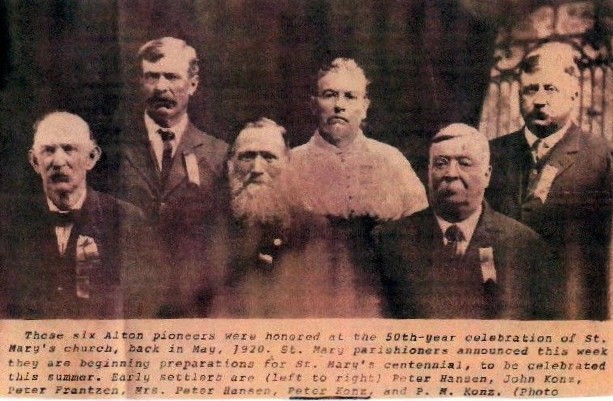
Ten years later, in May 1920, the people of Alton and the surrounding region commemorated the 50th anniversary of the first Luxembourger settlers in Sioux County. The “Alton Democrat,” Alton, Iowa, Saturday, May 22, 1920, featured a front-page article about the first settlers and a photo showing six surviving members of the original ox-drawn caravan: Peter Hansen, John Konz, Peter Frantzen, Mrs. Peter Hansen, Peter Konz and P. M. Konz. The article stated:
The people of Alton and many from Hospers and Granville gathered at St. Mary’s hall Sunday afternoon in honor of the old settlers who drove ox teams across the state from Jackson County and arrived here with prairie schooners 50 years ago, on May 19, 1870. Of the 40 who came then, only 12 are now living. They led the way and were the vanguard for the host that followed. Through their leadership came those who formed the large and prosperous settlement of Luxemburgers southeast and east of Alton.
Music by the Alton band opened the program in the afternoon but observance of the day was really started in the morning with mass by Rev. Father Brune and a special sermon by the Rt. Rev. Bishop Heelan at St. Mary’s Church. Bishop Heelan called attention to the vast contrast between the lot of these early pioneers 50 years ago and their lot today, terming this the richest community of one of the richest states in the union…
Of the twelve surviving members of the party who came by prairie schooner in 1870, only the six pictured above were able to the attend the celebration at St. Mary’s hall Sunday afternoon…
That same edition of the Alton Democrat, May 22, 1920, offered another editorial article on page four describing the experience of the early settlers:
Fifty years ago this May the earliest Luxemburg settlers came to Sioux county and 50 years ago came the earliest Hollanders from Pella. Since then the land has yielded bumper crops of untold value. The judgment of these brave and intrepid pioneers was wonderfully sagacious, their foresight a wonderful thing, their confidence in the future amazing.
These pioneers had no means of travel other than the ox team and the nearest village was LeMars, 18 miles away. There was nothing here when they came in the spring except prairie grass and man could not live on that. The virgin prairie was broken up, little by little, with such poor machinery as they had and their oxen. Clouds of grasshoppers destroyed their crops and they fought them to save enough to feed themselves over the coming winter with its terrible, sweeping blizzards and its deadly, freezing cold.
Were they afraid? No sir, they were not. These blazers-of-the-way set to work and built themselves habitations and shelters for their stock. They stayed. Their first years were full of hazards and grief but they stayed and most of them who now live still own the land which they so nobly earned or their children own it.
A year or two after the first “schooners” came the St. Paul and Omaha railroad built through and a station was built at Alton at the end of what is now Main street but for years after the railway came, the settlers continued to drive to LeMars and for fifteen or more years after the earliest pioneers had first marked it out, the wagon road remained. It followed no section lines; there were no fences and the road respected no man’s land but took the shortest possible course to LeMars. At first there was no scale at Alton for weighing grain, so the pioneers hauled their crops to LeMars and weighed the sacks of wheat there.
Sometimes, perhaps, these old settlers look back on the old days with regret that the times are so different now. Then the nearest neighbor was miles away, but his latch string was always out and there was always a hearty welcome to the visitor who must necessarily stay a couple of days at least to rest and visit. The stranger was always welcome. Hospitality was universal…
Memorial erected at original St. Donatus site
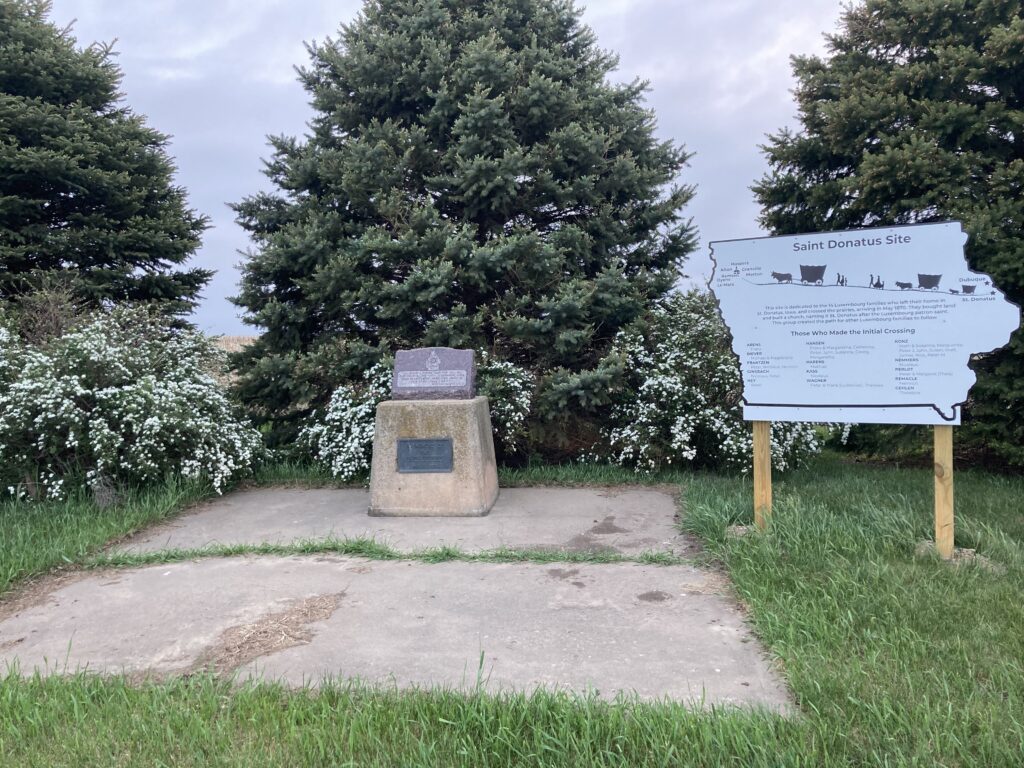
Over the years that followed, the original St. Donatus prairie site was not forgotten by the descendants of the first settlers and the Luxembourgers of the region. In 1964, Gerhardt Probst, whose ancestor Matt Probst had donated the original land for the church, suggested that a statue of the Blessed Virgin Mary be erected on the site of the old prairie church in honor of the early settlers. St. Mary’s Parish in Alton pursued the project and obtained a large concrete cast statue of Our Lady of the Prairie and had it set on a concrete base. The statue and memorial were blessed on Sunday, May 24, 1964. A bronze plaque with the inscription “In Memory of the Early Settlers – May 20, 1870” was added to the base of the monument as well as a list of the grade school students and members of St. Mary’s Parish who had contributed to the project.
Unfortunately, the statue was destroyed by vandals in March 1973. According to the Alton Democrat, March 21, 1973:
Some people seem to have a pretty distorted idea of what makes a rifle target. The Blessed Virgin Mary statue, located one mile west and three miles south of Alton, has recently been victimized by such thoughtless persons. Albert Hansen of Alton, who has provided information about the history of the statue, said that the beacon light out by the monument has been shot out quite regularly in the past, but this is the first time anyone has vandalized the statue itself.
Hansen was one of those who helped to erect the statue and he has recently been compiling a history of this area. According to his research, in 1870 a group of about 40 people came from St. Donatus, Iowa by oxen train to settle in East Orange Township. The group arrived on the 19th of May in that year. The first Catholic church was built on the southwest corner of Section 18 on eight acres of landed donated by Matt Probst. It was dedicated on September 12, 1881. In 1896, this church was torn down and some of the lumber was used to construct the now existing St. Mary’s church in Alton…
It’s a sad thing that some people have so little respect for what others have worked for, but someday they will understand.
Rather than replacing the statue, a granite marker was placed on the base, which features an etching of the Blessed Mother and a quote from 1 Thessalonians: “We always thank God for you all, for your active faith, inspiring love and persevering hope you have in our Lord Jesus Christ.” The marker and base can still be seen today at the St. Donatus prairie site. Five large evergreen trees serve as the backdrop for the memorial.
Commemoration of prairie site continues
In 2004, the nearby Luxembourg parish of St. Mary’s in Remsen celebrated the 100th anniversary of the dedication of their historic church. As part of the anniversary festivities, historian and now permanent deacon Rick Roder organized a 23-mile bike ride from St. Mary’s Church in Remsen to the St. Donatus prairie site to commemorate the Luxembourgish roots of St. Mary’s Parish, which originated at the St. Donatus site.
In May 2005, the Luxembourg Heritage Society of Northwest Iowa celebrated its first annual outdoor Mass at the St. Donatus prairie site as a commemoration of the 135th anniversary of the settlement in 1870. The society continues to celebrate an annual Mass at the site around May 20. In case of inclement weather, the Mass is celebrated at St. Mary’s Church in nearby Alton.
The year 2020 marked the 150th anniversary of the first Luxembourgers coming to northwest Iowa and settling near the St. Donatus prairie site. The Luxembourg Heritage Society of Northwest Iowa planned a grand celebration for the sesquicentennial on June 6-7, 2020. Unfortunately, the outbreak of COVID-19 caused the event to be postponed until June 5-6, 2021. That celebration was held at St. Mary’s School in Alton. The gymnasium was filled with family exhibits and memorabilia and well as booths with information about Luxembourg culture, dual citizenship and tours. Luxembourg beer and wine was provided by Honorary Consul of Luxembourg in Wisconsin Mike Ansay. Luxembourg’s Ambassador to the United States Gaston Stronck was present at the event. On Saturday afternoon, a Mass of Thanksgiving was celebrated in St. Mary’s Church to remember the original 38 Luxembourg settlers and all living and deceased Luxembourgers in the region.
New sign for prairie site
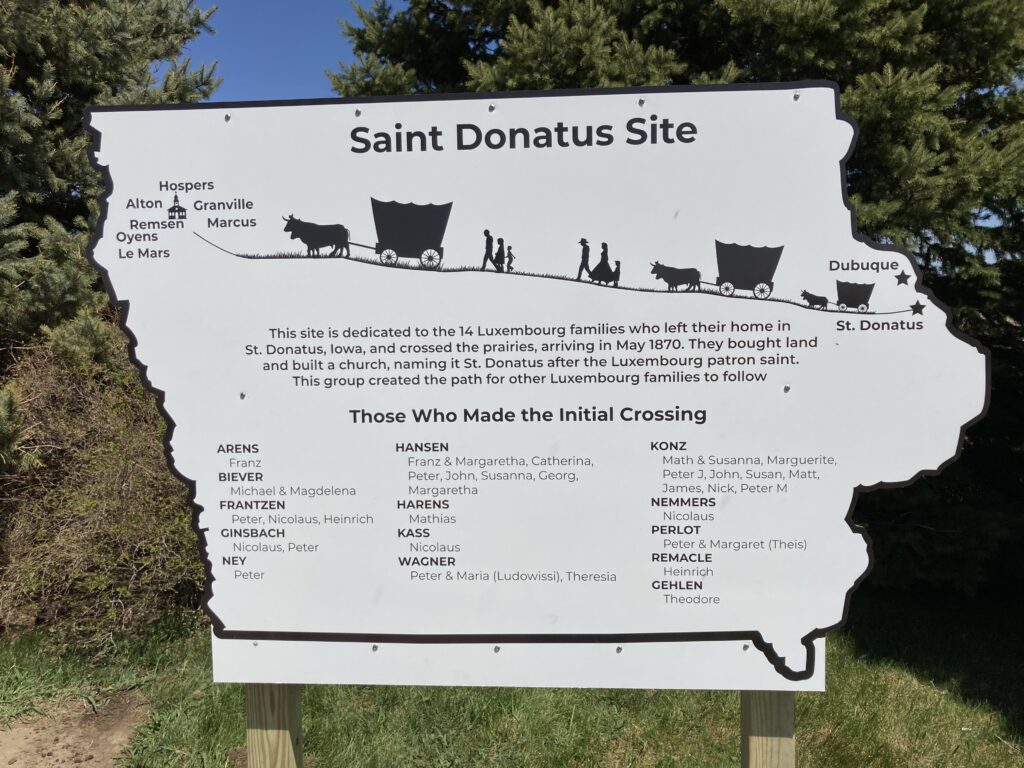
On Sunday, June 6, 2021, a new historic sign was dedicated and blessed at the original St. Donatus prairie site. Donated by the Luxembourg Heritage Society of Northwest Iowa, the aluminum Iowa-shaped sign tells the story of first Luxembourgers in the region in 1870 and lists the names of the first 38 settlers who make the trek from northeast to northwest Iowa. The sign reads:
St. Donatus Site
This site is dedicated to the 14 Luxembourg families who left their home in St. Donatus, Iowa, and crossed the prairies, arriving in May 1870. They brought land and built a church, naming it St. Donatus after the Luxembourg patron saint. This group created the path for other Luxembourg families to follow.
New St Donatus Parish
On January 1, 2025, the area Luxembourgish parishes of St. Mary’s in Alton, St. Joseph’s in Granville and St. Anthony’s in Hospers were combined and renamed as St. Donatus Parish. This name honors the original settlement site of the first Luxembourgers in the region.
Watch a video by Rural Adventurer about the pioneers of St. Donatus.
View the St. Donatus Luxembourg settlers’ memorial in Sioux County, Iowa, on Google Maps.
View a video about the first Luxembourg settlers to northwest Iowa in 1870.
View the website for the Luxembourg Heritage Society of Northwest Iowa.
View genealogy and photos for the first 38 Luxembourg settlers to Sioux County, Iowa researched and compiled by Robert Arens.
View a quick overview of the genealogy for the first 38 Luxembourg settlers to Sioux County, Iowa by Robert Arens.
St. Donatus Prairie Settlement
4100 480th Street
Alton, Iowa, 51003
Special thanks to Judy Stokesberry, Robert Arens, Rick Roder and Ric Hansen for their contributions to this article.
In the 1960s my family visited Alton IA many times. We had maternal relatives who lived there, including my great grandmother Sauer and my grandmother’s sister, Blanche (Sauer) Even. While visiting we attended Mass at St Mary’s. My great grand parents Peter and Anna (Jentzen) Treinen had moved to nearby Marcus IA in the in the time period when the first St Donatus church was built. Peter Treinen was one of four brothers who had immigrated to Minnesota. Peter and his spouse Anna Jentzen owned a farm two miles from Marcus. On a recent trip to Luxembourg, I found the grave site of my great grandfather’s sister in Arsdorf. Catherine (Treinen) Dording, her sister Mary and brother Nicholas had stayed in Luxembourg.
Until reading this article I had not known the Luxembourg connections to St Mary’s in Alton.
I grew up in Alton. My wife Joyce grew up in Granville. She is the great granddaughter of Peter ney who was one of the original pilgrims. Having been to the Granville church many times I never knew who the saint was in the st Joseph’s altar until now. I’ll be sure to look more closely the next time I’m there. Also it was a thrill seeing the comment from my distant relative on this site
This is a wonderful write up.
Last summer, my wife and I visited Luxembourg with my dad, Jim Ney. He is the great grandson of Peter Ney and grew up on a farm adjacent to Peter Ney’s homestead. We all fell in love with Luxembourg.
I’m Jim Ney, great grandson of Peter Ney, one of the first settlers in Northwest Iowa. I grew up on a farm near Granville part of which was the original Peter Ney Homestead. I lived my adult life in Albuquerque, New Mexico. I married Pauline Muehl from Granville also with deep Luxembourg roots. She and I traveled to Luxembourg a number of times the last time with our daughters, Michelle and Christine in 2018 when we were both 80 years old. Pauline passed away in 2020. I went back to Luxembourg with my sister and husband, Joyce and Mark Even in 2024 and in 2025 with my son, Randall and his wife Kathryn. My other great grandfather was Theodore Klein, who was born in Tadler, Luxembourg and the Parish in that village was called Saint Donatus.
I am Tom Hansen, Great great great grandson of Franz Hansen, and Great great grandson of Peter Hansen. I enjoyed this article. I am a member of the Northwest Iowa Luxembourg Society. Every year in June, for Luxembourg Flag day we put Luxembourg flags on the gravestones of the original settlers. Franz and Catherine Hansen are buried in Calvary cemetery in LeMars Iowa, Peter and Susan are buried in Alton St. Mary’s cemetery.