
The largest settlement of Luxembourgers in Wisconsin was the region of northern Ozaukee and southern Sheboygan counties, including the communities of Holy Cross, Lake Church, Dacada, Belgium, Port Washington, Fredonia and Waubeka. There are numerous other smaller Luxembourg communities in Wisconsin that have not been recognized or documented as thoroughly. One such community is St. Augustine in the Town of Trenton, Washington County, which neighbors Ozaukee County.
Luxembourgers settle in Washington County
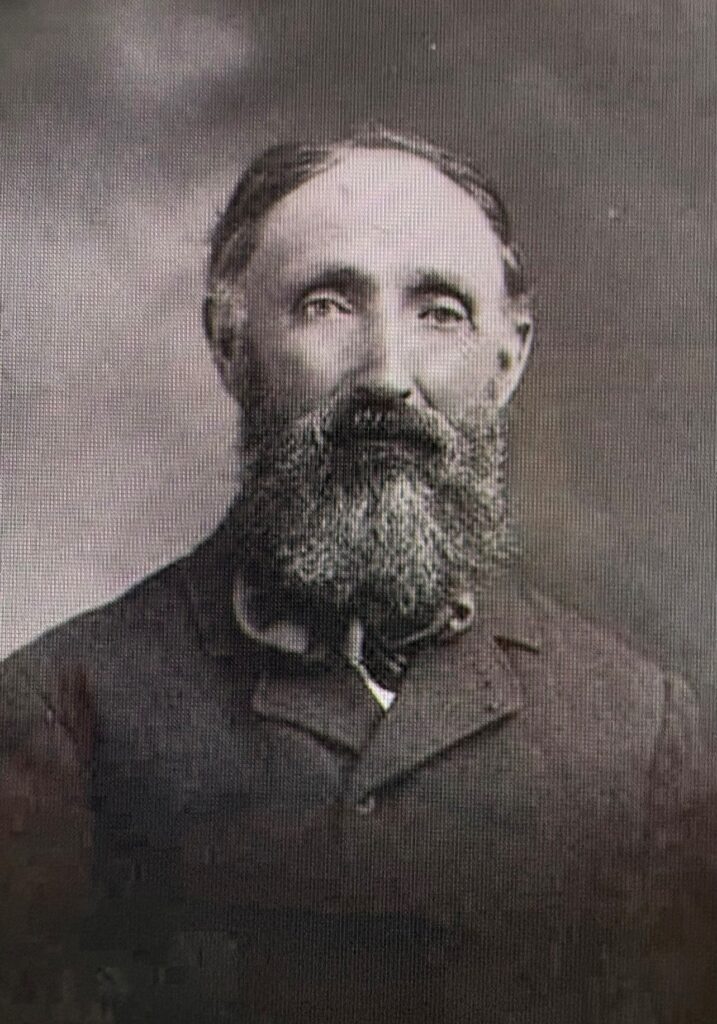
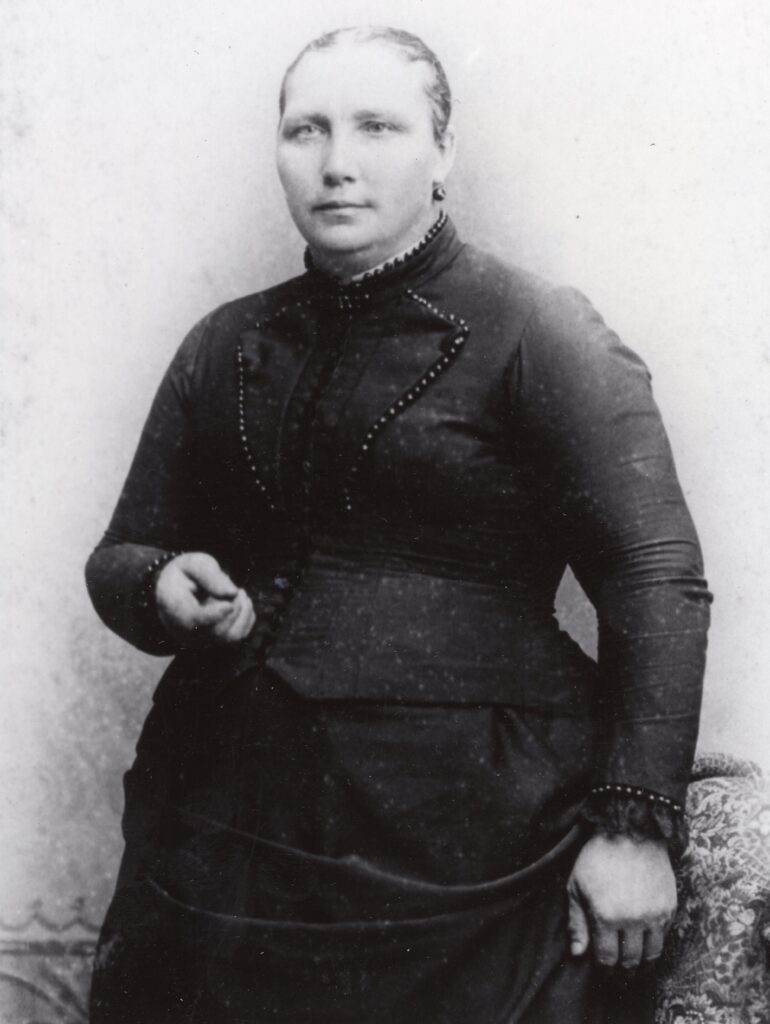
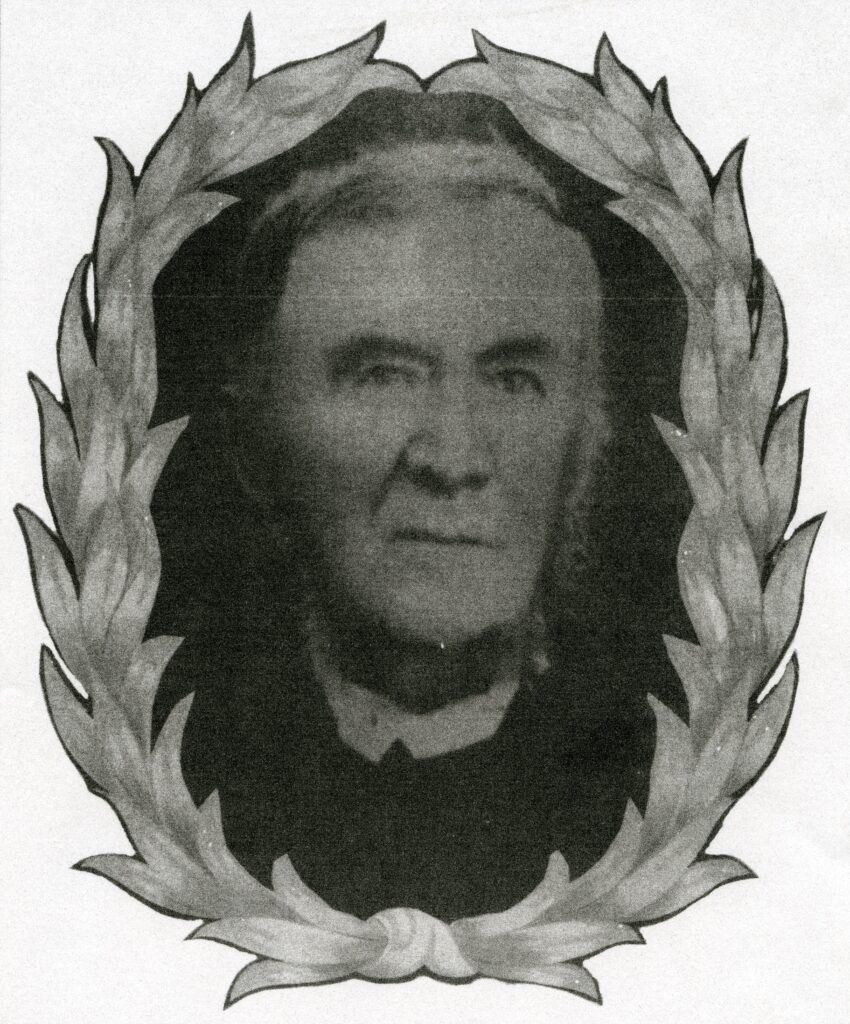
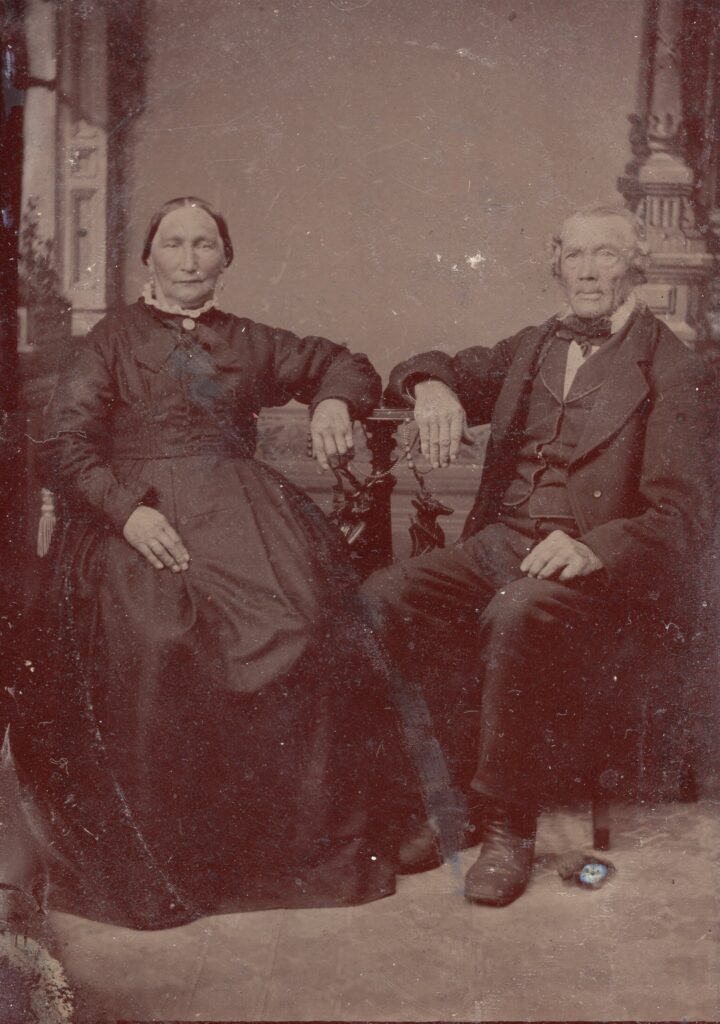
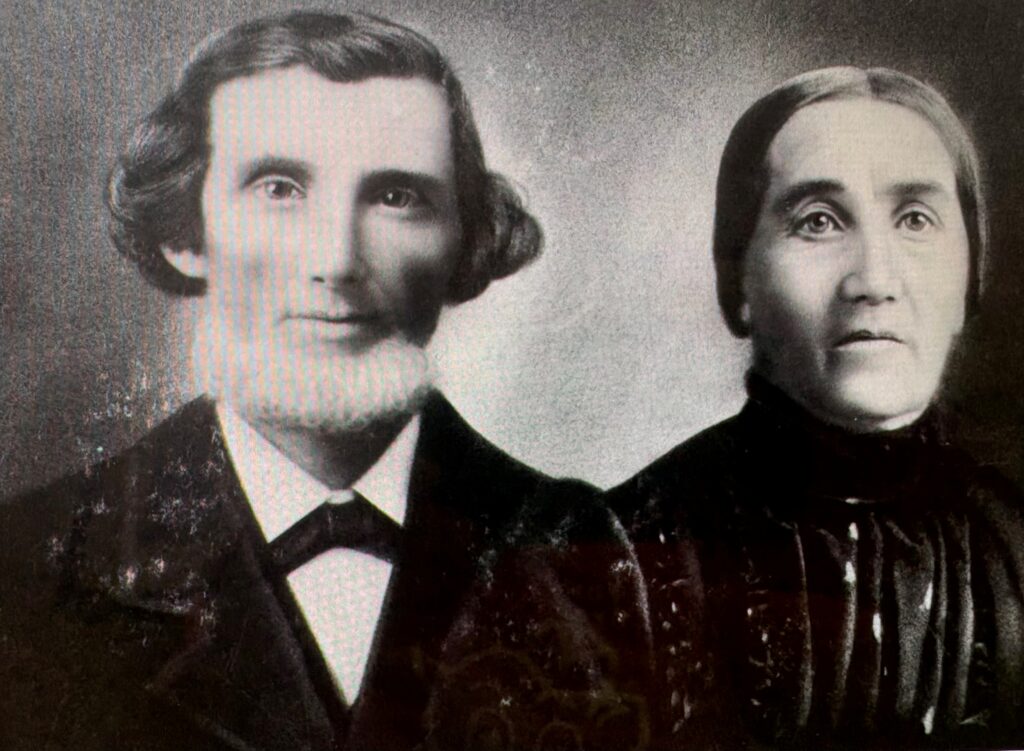
Luxembourgers started immigrating to Washington County in 1847 along with German settlers. Two of the first Luxembourger families to settle in the community that became known as St. Augustine were Martin and Helena (Jungers) Molling and Mathias and Anna (Mootz) Bach. Martin Molling was born in Elvange, Luxembourg, in 1807, and Helena Jungers was born in Altwies, Luxembourg, in 1810. Mathias Bach was born in Dalheim, Luxembourg, in 1814, and Anna Mootz was born in Schuttrange, Luxembourg, in 1823. The Mollings and the Bachs along with their children settled in Washington County in 1847 and helped form the new community and parish of St. Augustine. Other Luxembourgers followed in ensuing years.
These early Luxembourg settlers and their German counterparts settled in Wisconsin’s untamed wilderness. Martin Molling’s obituary from 1898 from an unidentified newspaper states:
…In 1847, he with his wife and small children came to America, and settled in Trenton, the same year on a farm three miles south of this village [Newburg, Wisconsin]. The vicinity was then a vast wilderness and they went through many hardships in preparing the land for cultivation and together toiled hard to gain a livelihood in those early days. However, by their thrift and frugality they acquired ample means…
Helena (Jungers) Molling must have written to her relatives back in Luxembourg, for within a matter of a few years, her brothers, John and Peter Jungers of Altwies, and other Rinn relatives from Dalheim immigrated to St. Augustine. The Molling and Bach families were joined by the following other Luxembourgish families:
Jungers (Altwies)
Winkel (Filsdorf)
Blau (Wormeldange)
Hann/Hahn (Waldbredimus)
Hames (Hassel)
Guidinger (Altwies)
Hansen (Heiderscheid)
Klein (Welfrange)
Berens (Waldbredimus)
Spenner (Wintrange, Dalheim)
Rausch (Welfrange)
Schuman (Dalheim)
Rinn (Dalheim)
Nicholas Gonner in his 1889 book “Die Luxemburger in der Neuen Welt” (Luxembourgers in the New World) wrote of the Luxembourgish residents of the Town of Trenton:
…Luxembourger families of Washington County who are identifiable, first, from the federal census of 1870 and, in some instances, from headstones in cemeteries of the parishes referred to above including the following…Town of Trenton: Mathias Bach, Jacob Hames, John Hansen, Michael Hardy, Peter and John Jungers, Peter Klein, John Mathin, Franz Molling, Nicolas Prevost, Peter Rinn…1
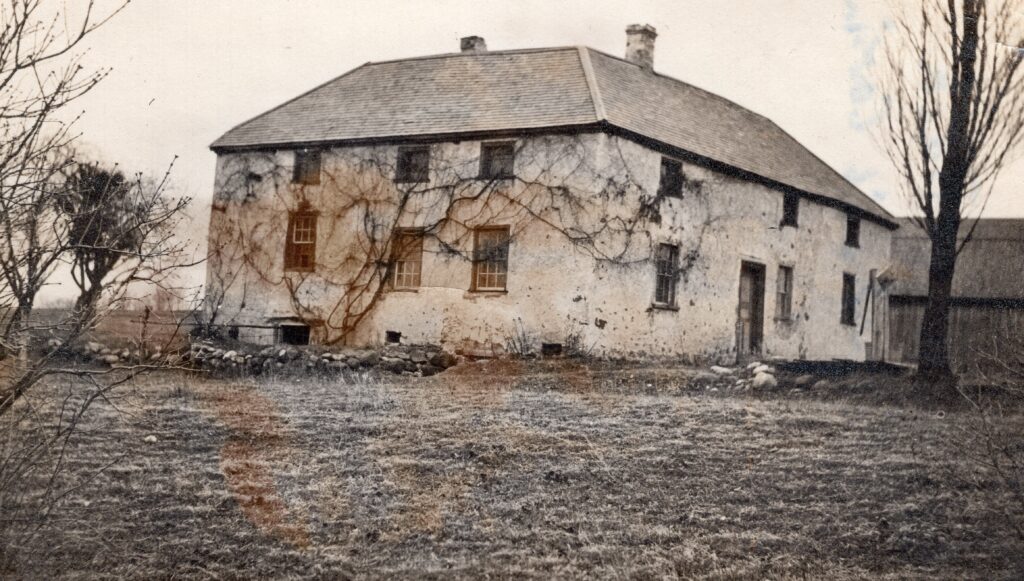
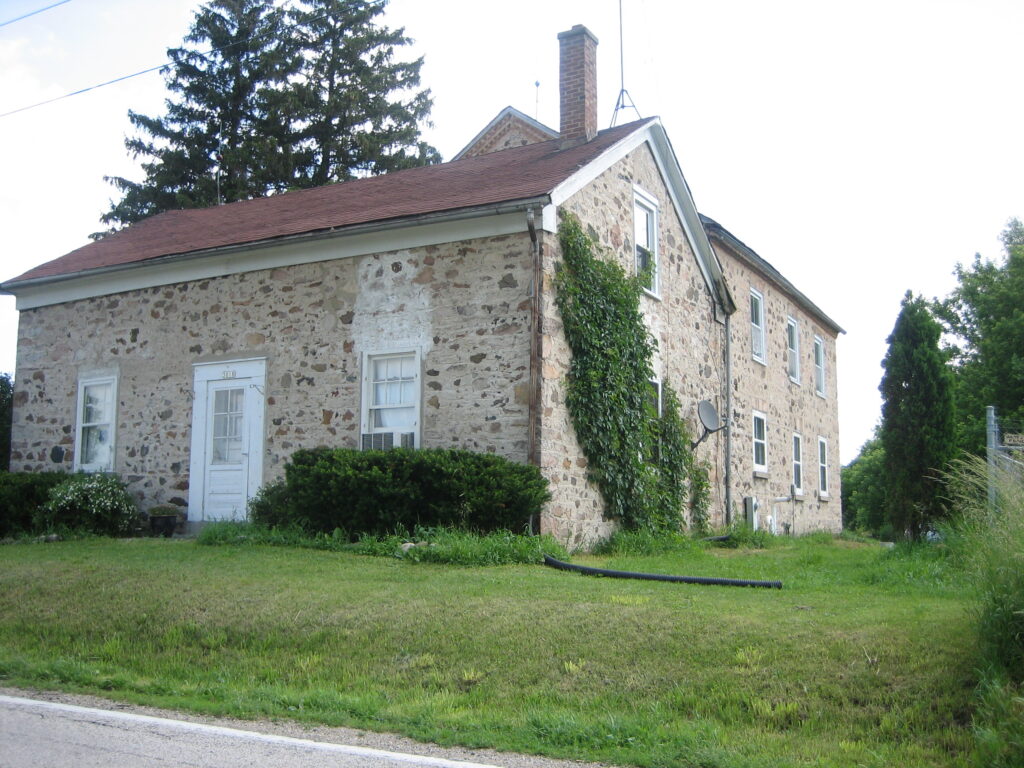
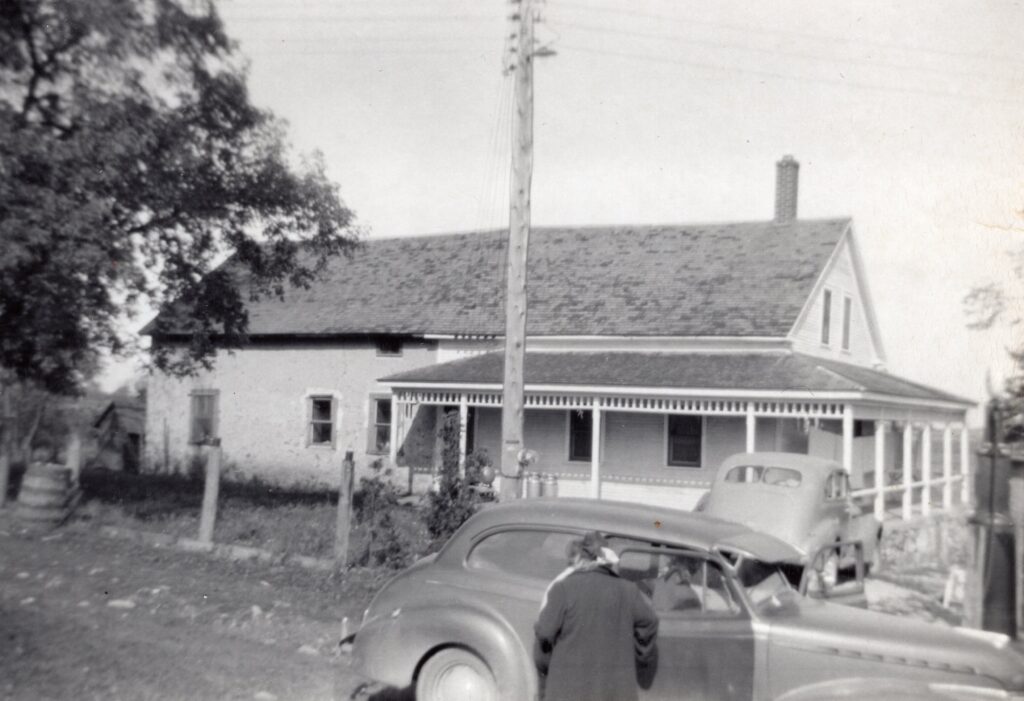
Some of these Luxembourgish families built traditional Luxembourgish stone houses on their farms in the Town of Trenton, including Martin Molling, Mathias Bach and John Jungers.
St. Augustine community and parish formed
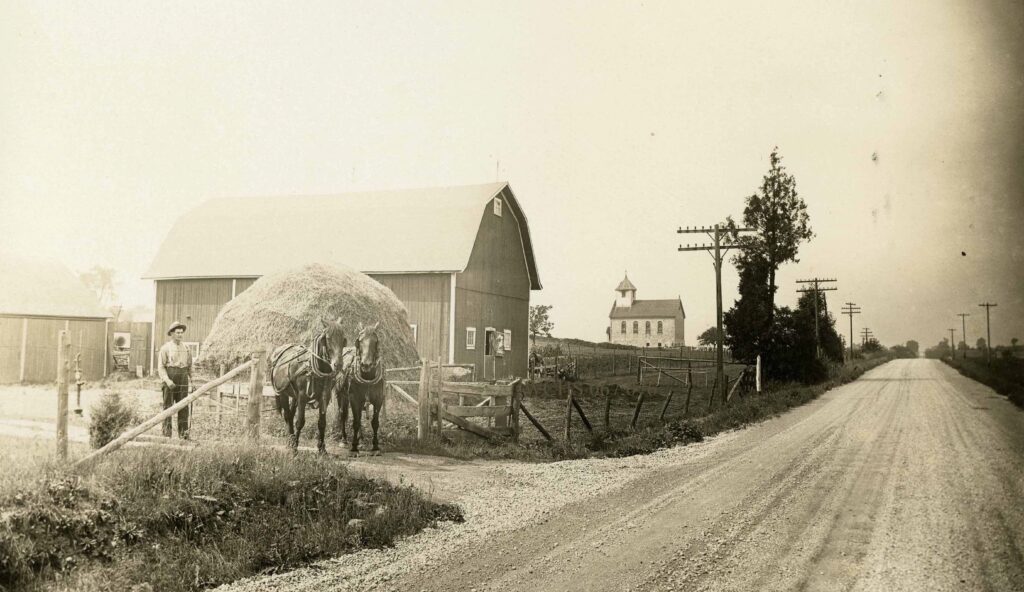
Over the years, St. Augustine did not develop into a significant community. It never had a general store or other businesses. Rather, St. Augustine could only be identified by its stone church, cemetery and Molling’s saloon and dance hall, kitty-corner from from the parish. The history of the Luxembourgers in St. Augustine and the development of their parish and building of the church are inseparable.
The story of St. Augustine community is best told in an article from an unidentified newspaper article from August 19, 1925, commemorating the diamond anniversary of the founding of St. Augustine Parish:
It was in 1847 that the first Catholic settlers came to what is now known as St. Augustine. These settlers for a time attended services in St. Xavier [St. Francis Xavier] church, in the town of Grafton [known as Town Ten], but as the distance to this was quite far from the settlement [approximately six miles], these settlers decided to establish a congregation of their own. They assembled on August 30, 1849, and at this meeting five settlers donated land for the purpose of having a church built upon it. Land was given as follows: Martin Wollner, 6 acres, George Weiss, 3 acres; Michael Weiss, 2 acres, Martin Molling, 2½ acres; Joseph Untz, 2 acres; total, 15½ acres. Temporary officers were chosen as follows: President, Martin Wollner; secretary, Joseph Untz; treasurer, Michael Weiss; collector, Mathias Waldkircher. The first meeting was held on September 23, 1849, at which the following signed the membership roll: Martin Wollner, George Weiss, Michael Weiss, Martin Molling, Joseph Untz, Daniel Driessel, Johann Krieg, Mathias Waldkircher, Egitus Engelhart, —- Etzel, George Schmidt and Mathias Bach.
On November 18, 1849, a survey was made of the church land and a deed given to the congregation, and it was ordered that notice be given to Bishop John Martin Henni of Milwaukee. The bishop’s acknowledgement was received December 12, 1849.
On March 4, 1850, the congregation had its first holy mass, this being read in the home of Michael Weiss, by Rev. Joseph Sattler. Services were held in the Michael Weiss home about two years and then a log cabin church was built on the present church grounds. From March 4, 1850, until November, 1850, services were held once each month, and thereafter services were held on three consecutive Sundays each month by Rev. Fabian [Bermadinger], who also gave religious instructions to the children.
A constitution and by-laws were adopted on December 26, 1850. At a meeting held on January 6, 1851, the following officers were elected: President, Mathias Waldkircher; secretary, Joseph Untz, treasurer, Michael Weiss; collector, Martin Wollner. The first financial statement was made, this showing the year’s receipts to have been $21.96, the disbursements $19.59, leaving a balance in the treasury of $2.37. It was voted that all new members pay a membership charge of $2.00.
On January 5, 1852, the church commission was elected as follows: President, Martin Molling; secretary, Joseph Untz; treasurer, Michael Weiss; collector, George Fechter; associate, —- Walz; overseer, Mathias Bach…..
It is not possible for us to give an account of many of the events of this old congregation, some of the minutes in the record book, although written with pen and ink, having become so faded that they are no longer legible. But we find some other notes besides those given above, which are of interest, namely:
Some of the older members of the congregation besides those named above were Joseph Daufen, Peter Rinn, John Jungers, John Boehm, Edward Wollner, Edward Blau, Franz Bach, Adam Wollner, Adam Hoff, Mathias Bales, Lorenz Wisinski, Joseph Roeckl, and Joseph Simon.
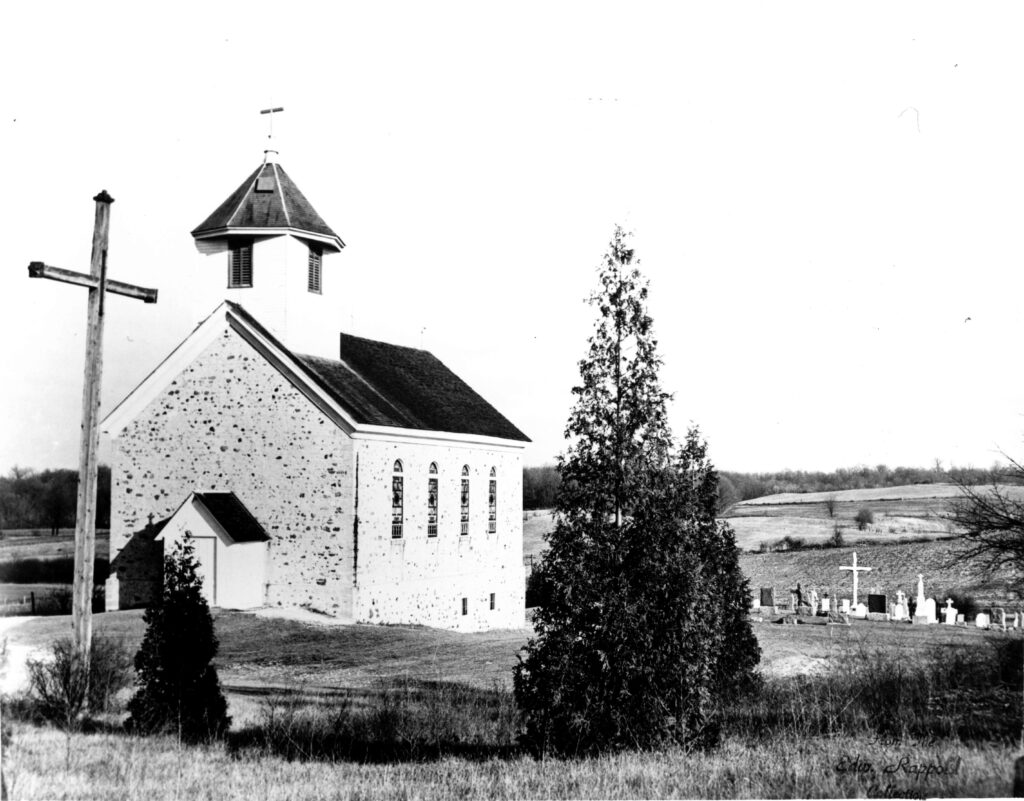
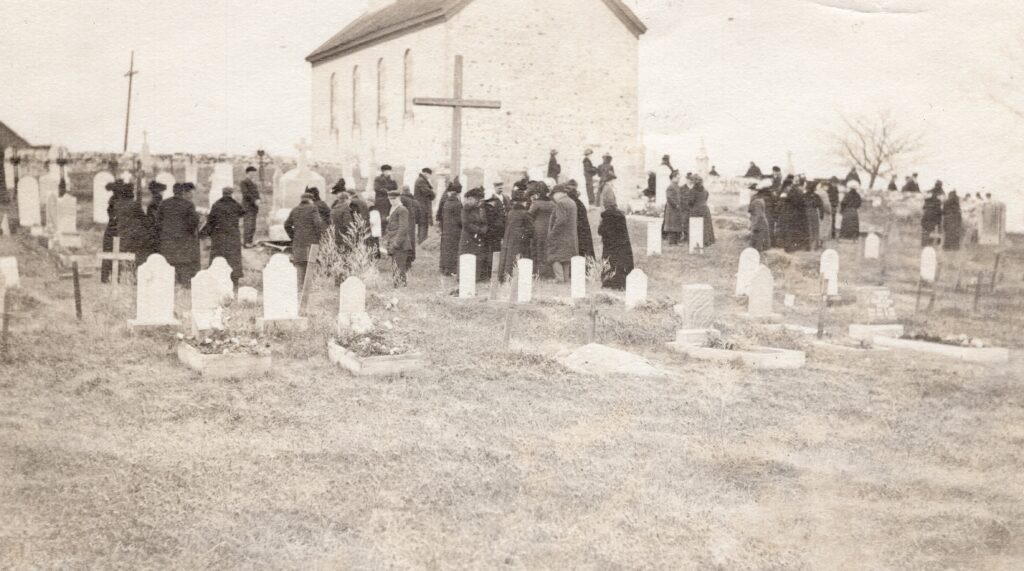
The cross shown in the photo at the top of the story was erected on the church grounds in 1860, a missionary father, name T. H. Weninger, officiating at the dedication. Martin Fechter, who has for some time made his home with his son-in-law and daughter, Mr. and Mrs. Wm. Kortendick, at West Bend, was an acolyte at the cross dedication. This cross was of solid wood, but it has become so worn by age that only a wood-shell remains, and for safety’s sake it will, no doubt, soon be taken down.
The present church was erected in 1861 [it has been determined that it was actually built in 1856]. In it the well-known Rev. Casper Roehrl of Barton officiated at many masses, and Rev. William Engel also served as priest, the latter’s salary being $100 per year. Sisters from the old convent in Barton [Sisters of St. Agnes, now based in Fond du Lac, Wisconsin], gave instructions at times in the basement room of the church. St. Augustine’s congregation has on its present membership roll about forty families. For many years past, the church has been a mission of the church at Newburg, the resident priest of Newburg conducting services at regular intervals.
The deed for the original donation of 15.5 acres of land for St. Augustine Church is dated November 13, 1849. It lists the following individuals as the donors: Martin Wollner and Barbara, his wife; George Weiss and Elisa, his wife; Michael Weiss, Martin Molling and Helen, his wife.2 The parcel of land they donated was located on the edge of the Town of Trenton with the Town of Saukville directly across the road. When Ozaukee County was formed from Washington County in 1853, the road on which St. Augustine Church was located became the dividing line with Washington County on the west side of the road and Ozaukee County on the east side. Thus, some parishioners resided in Washington County and some in Ozaukee County.
Because St. Augustine was often served by the priest who pastored St. Francis Xavier Church in what was known as Town Ten, the Town of Grafton, Ozaukee County, many of the early baptisms, marriages and burials from St. Augustine Church are recorded in the sacramental records affiliated with St. Francis Xavier Church.3
Stone church is built
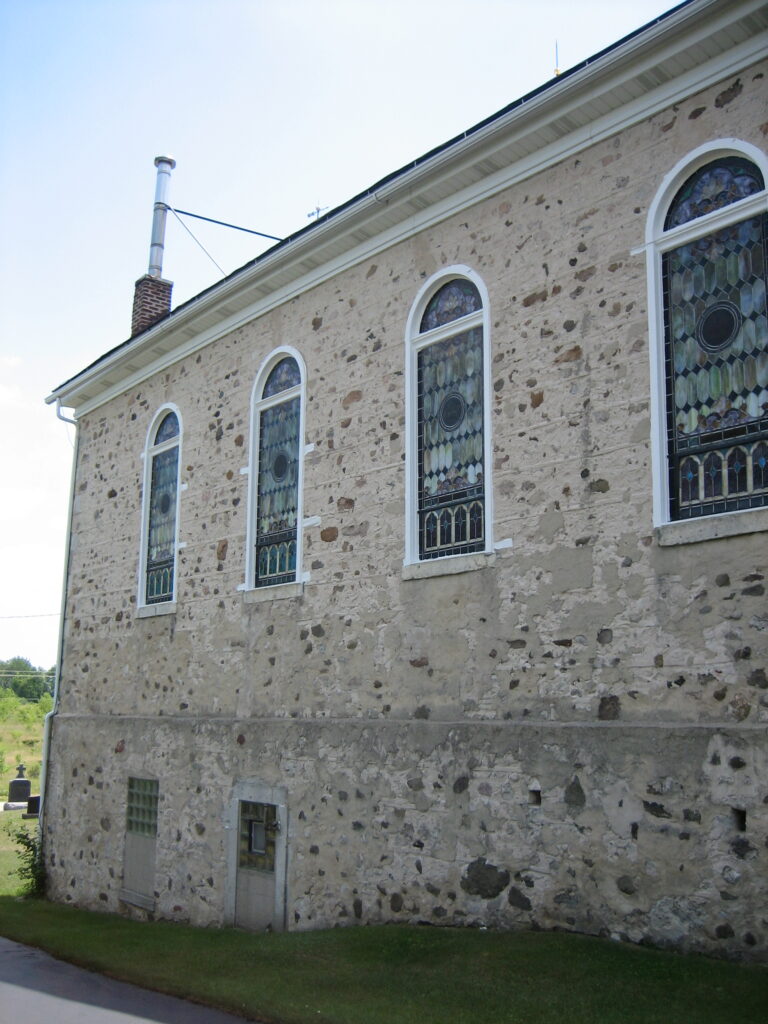
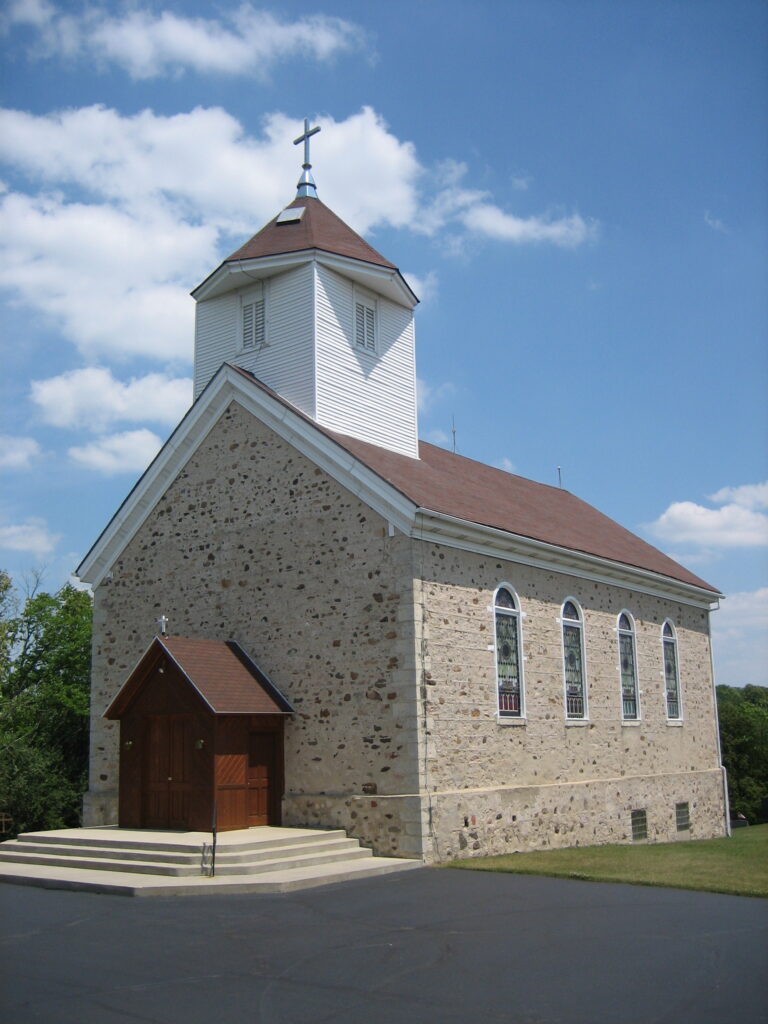
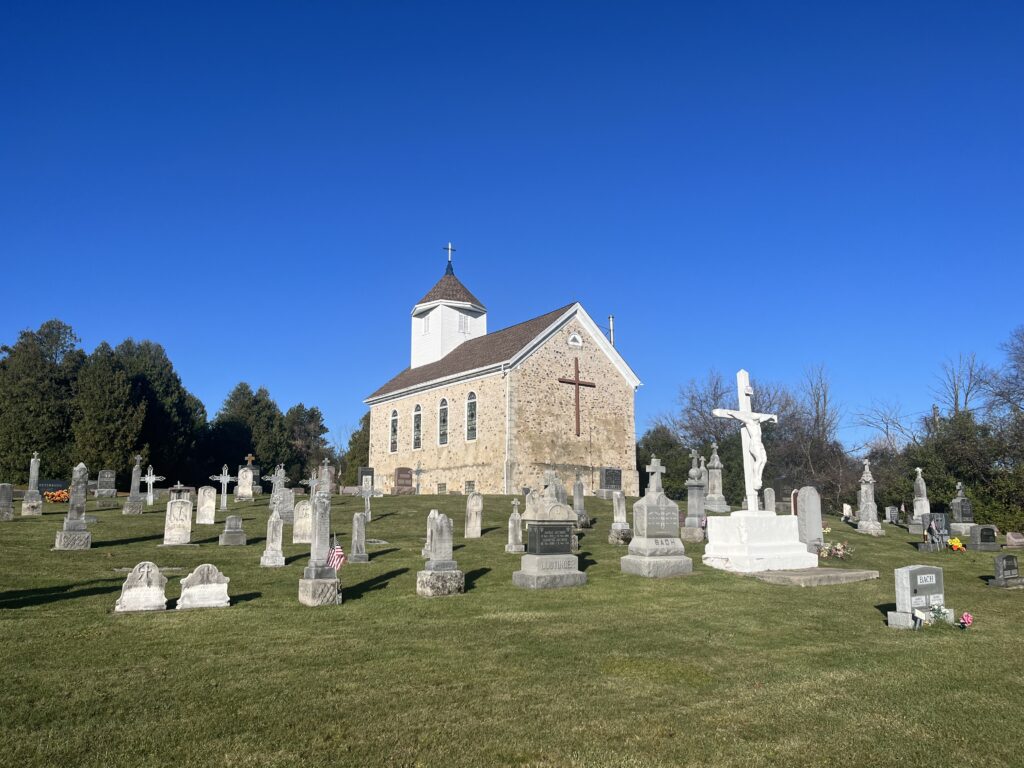
St. Augustine Parish built its little fieldstone church in 1856 in the Romanesque Revival Style. The upper walls of the church are 2.5 feet thick, and the lower walls are 3 feet, 3 inches thick. The wooden steeple that houses the bell has an octagon roof. The bell was forged by the Meneely Bell Company of West Troy, New York, in 1863. The bell has always been rung by hand and has a rope that extends down to the ground level of the church. There are eight stained glass windows with limestone sills and wooden frames. The windows, designed by Milwaukee Mirror and Art Glass Works were installed in 1906.4
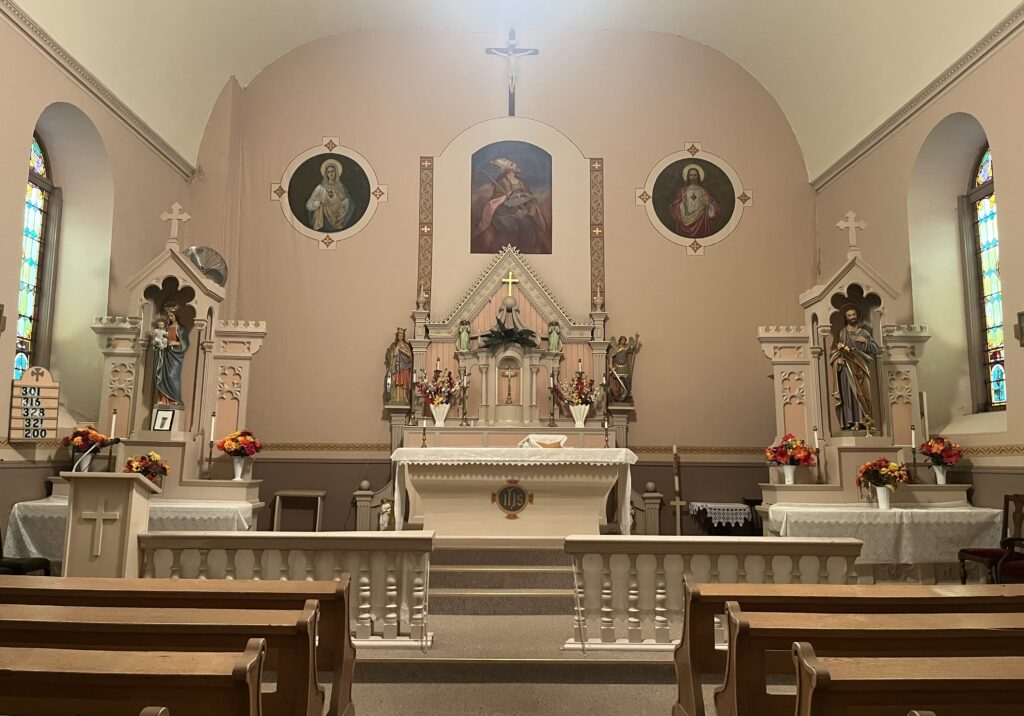
The church choir loft has a curved staircase with decorative Maltese crosses within a circle. There is a pump organ in the loft dating back to 1882, which was built by the Earhuff Organ Co. of St. Paul, Minnesota. A newer Allen organ was purchased in 1977.5
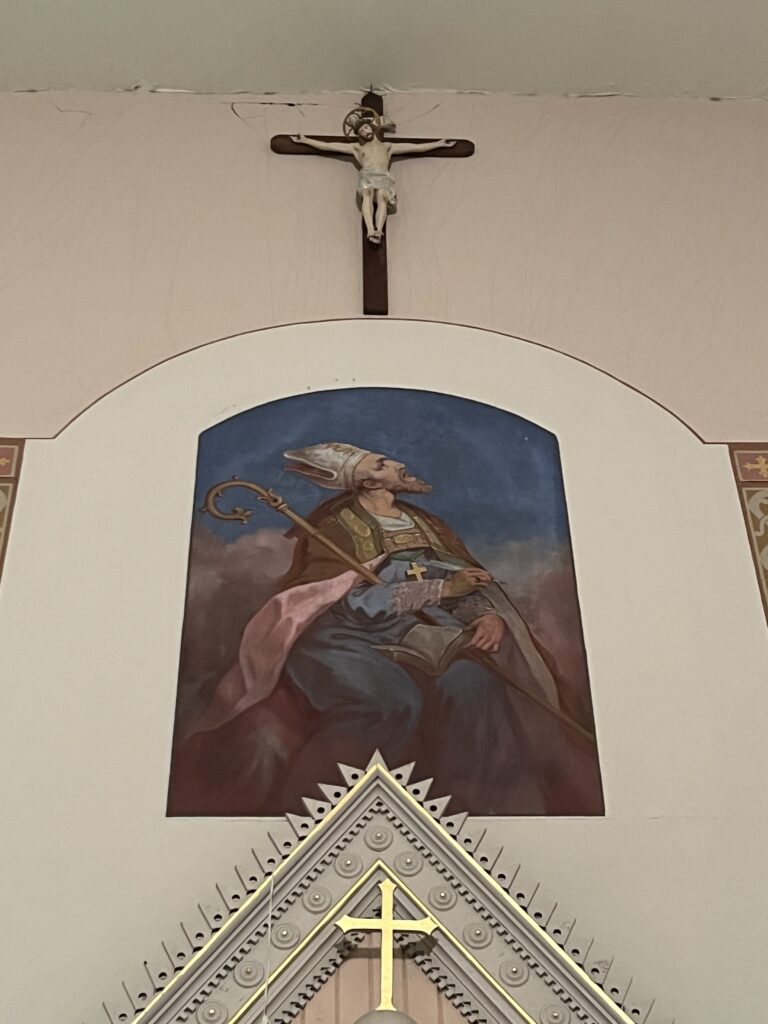
The walls and ceiling of the church are covered with canvas. There are 22 oak pews. A painting of St. Augustine above the high altar is flanked by paintings of the Sacred Heart of Jesus and the Immaculate Heart of Mary. The statues on the main altar are of St. Catherine of Alexandria and St. George of Cappadocia.6
St. Augustine Church has remained virtually untouched over the years and today, still looks basically the same as it did 168 years ago. Its noble simplicity coupled with its location atop a small hill overlooking the parish cemetery makes it one of the most picturesque churches in the region.
One curiosity about the stone church is that it appears to be built “backwards” with the steeple and entrance of the church facing away from the road. An article from the “Milwaukee Journal,” Milwaukee, Wisconsin, February 12, 1950, reported:
The St. Augustine Catholic Church, situated on county trunk Y, situated a few miles south of here [Newburg], turned its back to the road nearly 100 years ago and has never reversed that position. When the parish first was organized, services were held in settlers’ homes. Then a log church was built, facing in conventional fashion toward the road.
Why the present church was built “turned around” is a disputed question. One version is that the builders expected the road to be rerouted in front of the church. This is denied by old-timers, however. County trunk Y is the dividing line between Washington and Ozaukee counties. The settlers must have known, the argument goes, how difficult it would have been to change a county line. George Weiss, 94, of Newburg, one of the congregation’s oldest members, believes that the church was built facing away from the road because it had a school in the basement. The church was built into the side of a hill and the pupils could enter their classroom without climbing stairs.
One old parishioner said he remembers the priest was supposed to have said he wanted to be facing the rising sun when he said mass.
Whatever the reason, the subject of why the church was built that way is apt to come up next summer when parishioners gather to celebrate the church’s centennial.
St. Augustine Church survives ravages of time
While the St. Augustine community grew a bit over the years, it was overshadowed by the faster-growing community of Newburg, which was situated 3.5 miles north on the Milwaukee River. Commerce began to take shape in Newburg and in 1859, the new Catholic parish of Holy Trinity was formed. Little St. Augustine Church soon became a mission of Holy Trinity Parish in Newburg, a situation which continues to this day. For many years, Sunday Mass was celebrated in St. Augustine Church on two Sundays per month by the pastor of Holy Trinity.
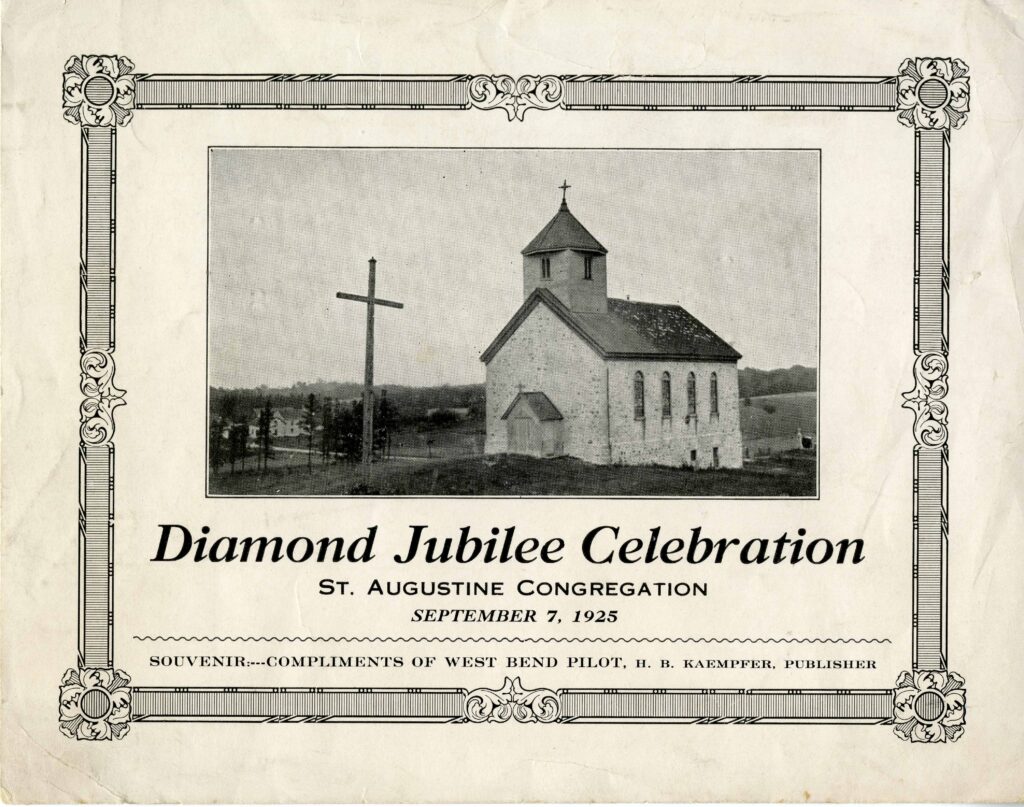
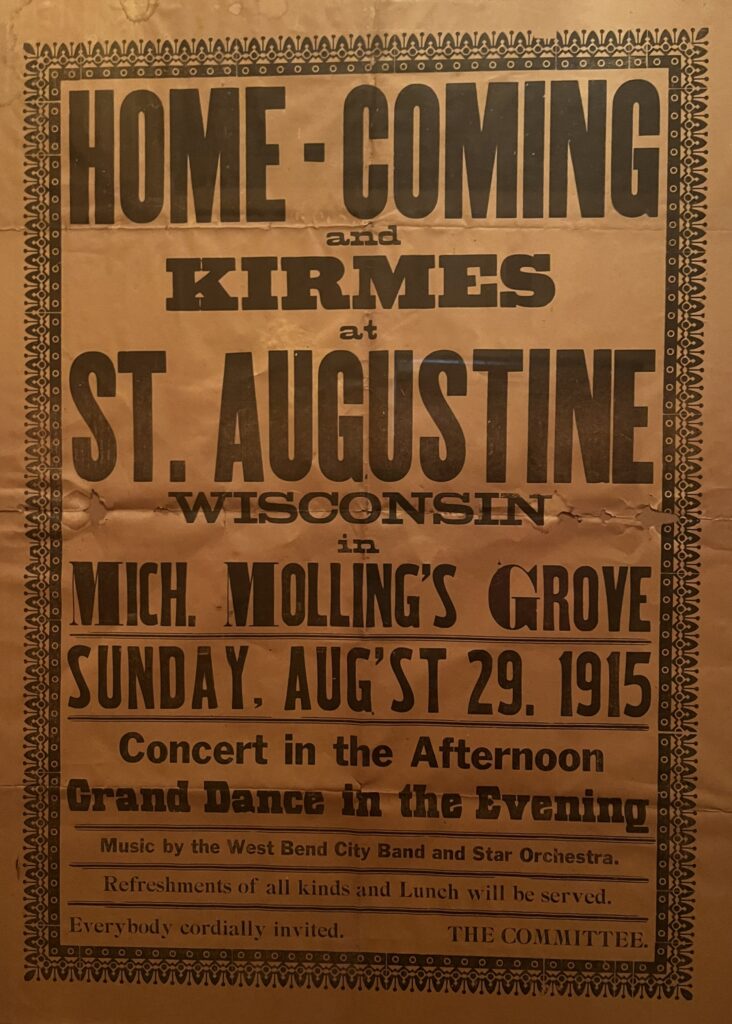
In 1900, St. Augustine Church celebrated its Golden Anniversary. In 1925, the Diamond Jubilee was celebrated with a solemn High Mass, a procession to the nearby Molling orchard picnic grounds, a card party in Molling’s Hall, as well as a chicken luncheon and another meal in the evening.7 In 1950, the parish celebrated its centennial with a solemn High Mass.8 In 1957, electricity was installed in the church. In 1968, the altar table was separated from the high altar to conform with the liturgical renewal of Vatican II. In 1975, a celebration was held for the parish’s 125th anniversary with a Sunday morning Mass and a noon dinner and reception at nearby Holy Trinity Church in Newburg.9 In 1990, St. Augustine Church was inducted into the National Register of Historic Places by the U.S. Department of Interior.10 In 2000, the parish celebrated its 150th anniversary with a Mass followed by a parish picnic.
Today, St. Augustine Church is no longer used for any regular weekend or weekday Masses. It is available for weddings and funerals for past members. An annual Christmas Eve Mass is celebrated at St. Augustine as is the annual Kirmes (church patron saint anniversary), which is celebrated the last Sunday of August, corresponding to the traditional feast day of St. Augustine on August 28. The building continues to be under the jurisdiction of Holy Trinity Parish in nearby Newburg. St. Augustine cemetery and church grounds are cared for by the St. Augustine Cemetery Committee.11
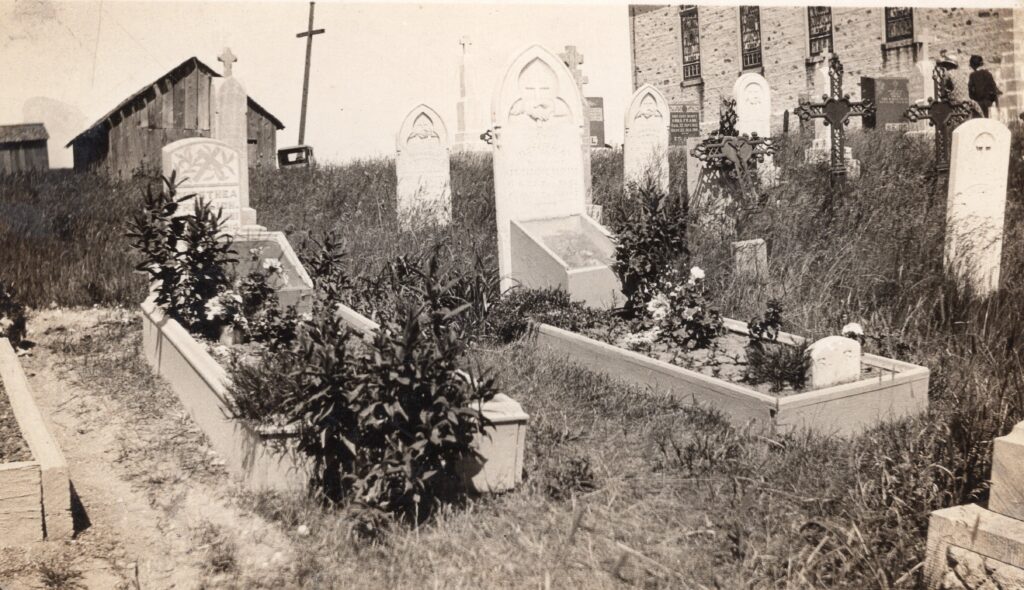
One need only walk through the historic cemetery at St. Augustine and neighboring Holy Trinity Cemetery in Newburg to see the names of the early Luxembourg settlers who helped bring the St. Augustine community to life.
St. Augustine Church is located at 5479 County Y, West Bend (Town of Trenton), Wisconsin.
Enjoy Kevin’s videos:
St. Augustine Church and Cemetery
Interior of Historic St. Augustine Church
Discovering My Distant Cousins with Roots in St. Augustine
Mathias Bach Stone House in St. Augustine, Wisconsin
0 Comments