
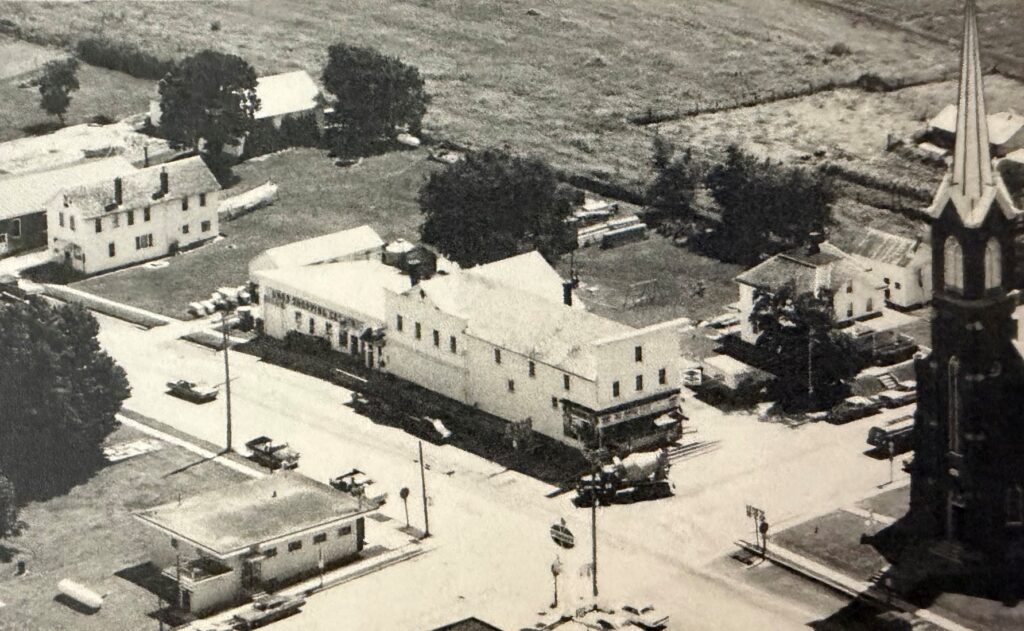
Throughout the years, several U.S. communities have been named Luxemburg (the German spelling for Luxembourg), including Luxemburg, Missouri (now the St. Louis suburb of Lemay); Luxemburg Ravine, California (a former Luxembourger gold mining settlement); Luxemburg, Mississippi; Luxemburg, Nebraska (now Bellwood, Nebraska); Luxemburg, Iowa; Luxemburg, Wisconsin; and Luxemburg, Minnesota. In 2026, only three of these communities remain: Luxemburg, Iowa; Luxemburg, Wisconsin; and Luxemburg, Minnesota. In this article, we will explore Luxemburg, Iowa.
Early Luxembourgers settle Luxemburg, Iowa
Luxemburg, Iowa, in Liberty Township in Dubuque County, is about 40 minutes northwest of the City of Dubuque. This rural farm community with a current population of 234 has been home to numerous Luxembourgers since 1846.
Luxembourg journalist Roger “Rosch” Krieps visited Luxemburg, Iowa, during his 1962 Millennial Mission to the United States in anticipation of Luxembourg’s Millenium celebration in 1963. That visit to U.S. Luxembourg communities led to the publication of his book “Luxemburger in Amerika” in 1963. Historian Fausto Gardini translated the original German text into English and Krieps’ book was republished in 2013 as “Luxembourgers in America.”
After visiting Luxemburg, Iowa, Krieps wrote:
Already in 1846, our first compatriots arrived in the area: Peter Henkels, five brothers Heiderscheit, M. Marnach, M. Wagner, B. Kayl and Nicholas Ungs. At the same time Germans from Westphalia, Hanover and Oldenburg arrived, but the Luxembourger language imposed itself, as did the name of the village.1
In the 1850s and 1860s, more Luxembourg and German immigrants settled in Liberty township and Luxemburg, Iowa came to life. When the first post office opened in 1860, it was given the name Allison after a U.S. Sen. William Allison, of Dubuque. However, letters and documents from this era were addressed Luxembourg (Allison P.O.) giving the impression that the town was known as Luxemburg from the early days of its settlement.2 Interestingly, early it its history, it was also referred to as “Flea Berg” or “Flee Hill.” According to the book “City of Luxemburg, Iowa – 1912 – Celebrating 100 Years – 2012”:
…There seems to be some confusion about the early name of the town. Some called “Fleeberg” from the Low German word “floeten” [whistling], suggested by the sound of the whistling winds across the open prairie.3
In his 1889 book “Die Luxemburger in der Neuen Welt” (“Luxembourgers in the New World”), Nicholas Gonner offers a similar explanation:
…The locality earlier was known as Allison in honor of a United States senator. The name was officially changed a few years before 1889. However, residents refer (1889) to the village as “Fleeberg” or “Feehill,” not because the place is infested with little creatures but because in Low German, the words floeten, fleiten and fleeten are applied to the howling of the wind…4
While this is one account of the origin of the name, Krieps, in his 1963 book, offers another:
Luxemburg, Iowa is commonly referred to as Fle’bierg [Flea Town] or Fle’hill [Flea Hill]. In an attempt to make the name acceptable in better quarters, Gonner [Nicholas Gonner, editor of the Luxemburger Gazette in nearby Dubuque] interpreted the place name as being a derivative of “fleten,” the Luxembourgish word for playing a flute or whistling, because on the Fle’bierg the wind whistles coldly. According to Gonner, the place name had nothing to do with certain pests as some people have insinuated. A traditional, old local legend actually tells the story of a vagrant, who one evening wanted to spend the night in Luxemburg, Iowa. He was allowed to do so. The next morning, instead of thanking his hosts, the chap complained that there had been fleas in his bed. That was the story that he then carried around throughout the area and that’s how the settlement came about its ambiguous nickname. The inhabitants of the village are by no means as upset as the editor of the Luxemburger Gazette had been in his book.5
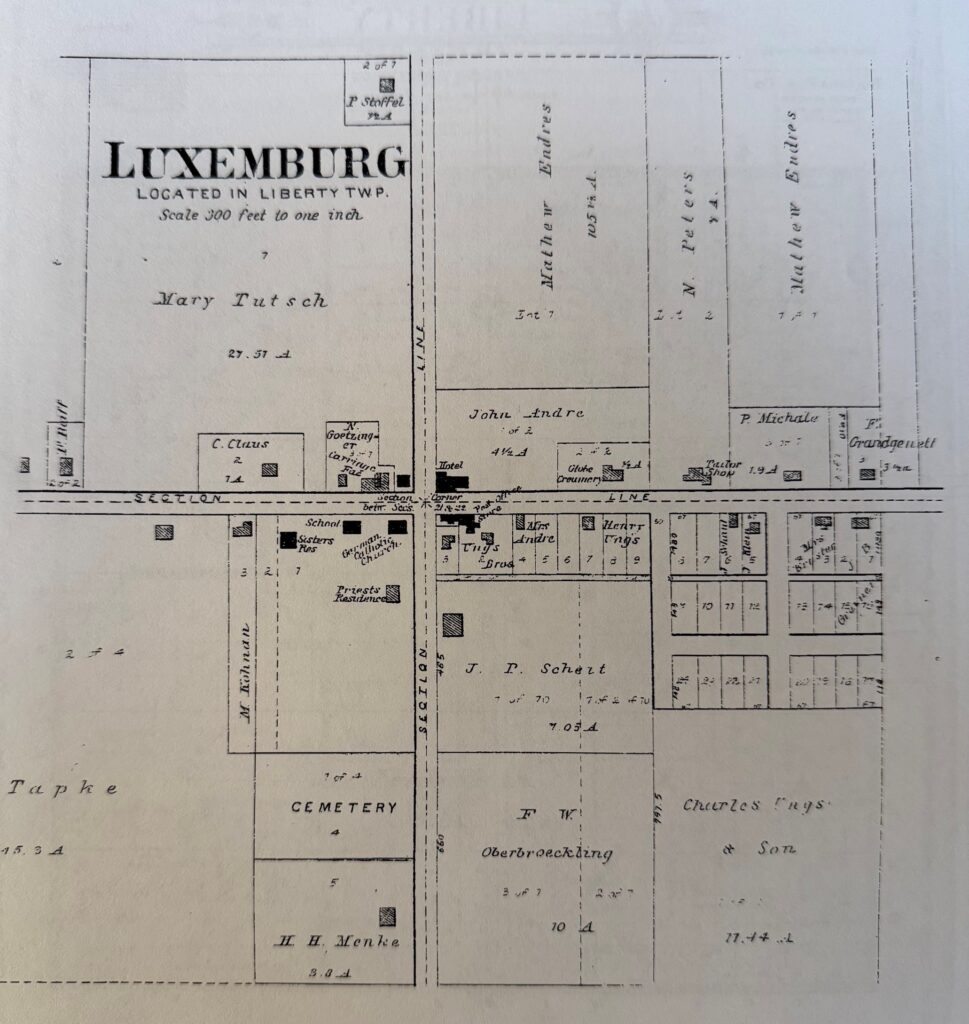
Most of the early Luxembourg settlers farmed while a few proved themselves as entrepreneurs and began businesses in Luxemburg including Nicholas Goetzinger, blacksmith and carriage builder, Nicholas Andre and Ungs family members, general store, saloon and post office. According to a 1892 plat of the village of Luxemburg, the community was home to a carriage factory, post office, general store, hotel, creamery, tailor shop and a German Catholic church, school, priest’s residence and sisters’ residence.6
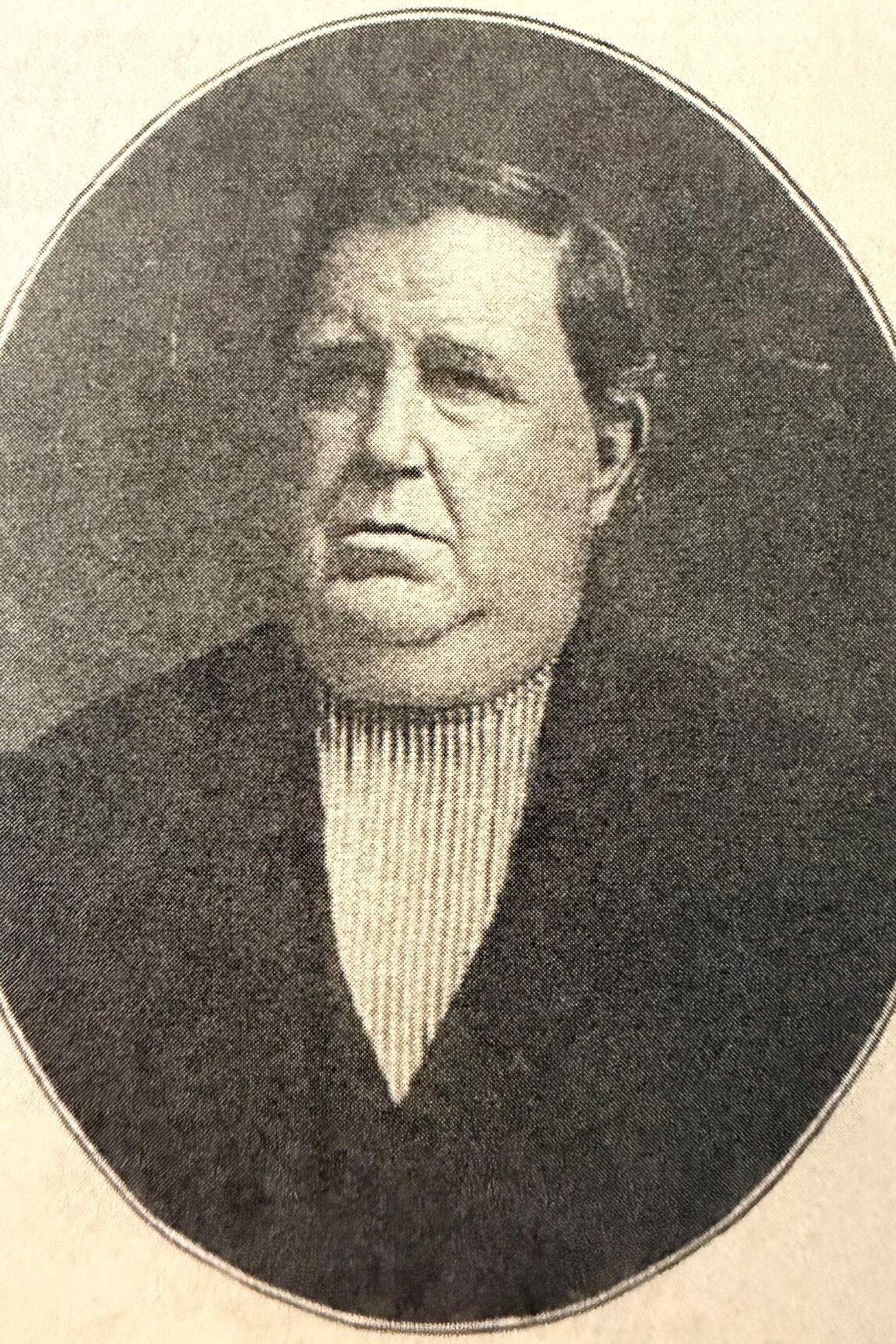
Below is a list of some of the Luxembourg immigrant families who settled in Luxemburg, Iowa, and the surrounding townships.
Andre (Elvingen)
Arens (Olm)
Bries (Pratz)
Claus (Esch-sur-Alzette)
Clemen/Cleman (Consdorf)
Duster (Beaufort)
Ernster (Waldbredimus and Roedt-les-Trintange)
Gaul (Pratz)
Goetzinger (Greiveldange)
Grommersch (Steinheim)
Gudenkauf (Leudelange)
Heiderscheit (Pratz)
Henkels (Buschrodt)
Hess (Beaufort)
Kaber (Oberfeulen)
Kayl (???)
Kohnen (Niederfeulen)
Konsen (Kruchten)
Ley (Pratz)
Linck (Oberfeulen)
Marnach (Oberfeulen)
Momper (Attert, Province of Luxembourg, Belgium)
Pfeffer (Mertzig)
Pleschette/Pletchette (Oberfeulen)
Rausch (Moestroff)
Redlinger (Waldbredimus)
Schaul (Oberfeulen)
Schiell (Nagem)
Semmerl (Oberfeulen)
Spoden (????)
Stoffel (Mertzig)
Streff (Ellange)
Stronck (Haller)
Theisen (Girst)
Ungs (Beaufort)
Wagner (Oberfeulen)
Weis (Niederpallen)
Welter (Beaufort)
Willmes (Kaundorf)
Check out Kevin’s video from Luxemburg, Iowa: Greetings from Luxemburg, Iowa
READ PART 2 NEXT MONTH: PARISH, COMMUNITY, CULTURE AND CONTINUING BONDS WITH LUXEMBOURG.
0 Comments