
Many of us with Luxembourg or Belgic-Luxembourg immigrant ancestors might know their names, their year of birth, village of origin in Luxembourg, the year they immigrated, the year they died and the place they are buried. But for most of us, the story behind the why and how they left Luxembourg for a new life in America remains a mystery. In this series, we provide knowledge and insight into why and how your ancestors left the country they loved for the land of opportunity. This third article is about The Derulle-Wigreux-Weitzel travel agency of Luxembourg, which from 1870 to the 1960s facilitated emigration for tens of thousands of Luxembourgers to the United States, Canada, Argentina, South Africa and other parts of the world. This story will be told in three parts.
The Derulle-Wigreux-Weitzel Emigrant Agency
By Kevin Wester
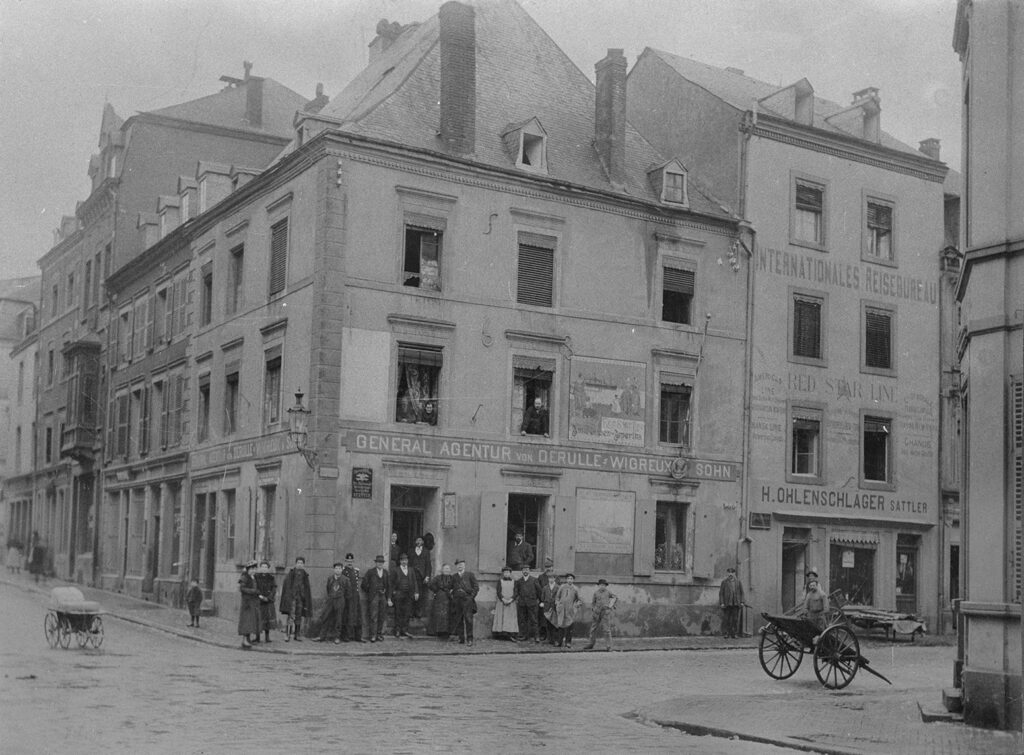
From 1870 to the 1960s, the Derulle-Wigreux travel agency of Luxembourg facilitated emigration for tens of thousands of Luxembourgers who desired a new life in the United States, Canada, Argentina, South Africa and other parts of the world. While a few other emigration agents operated in Luxembourg, Derulle-Wigreux can rightfully be considered Luxembourg’s premier travel agency for emigrants by the sheer number of clients they served during their 100+ year history. The Derulle-Wigreux tradition continued for three generations. In 1926, the Weitzel family of Luxembourg took over ownership and management of the company and carried on the Derulle-Wigreux tradition.
Emigration and emigration agents in the 19th century
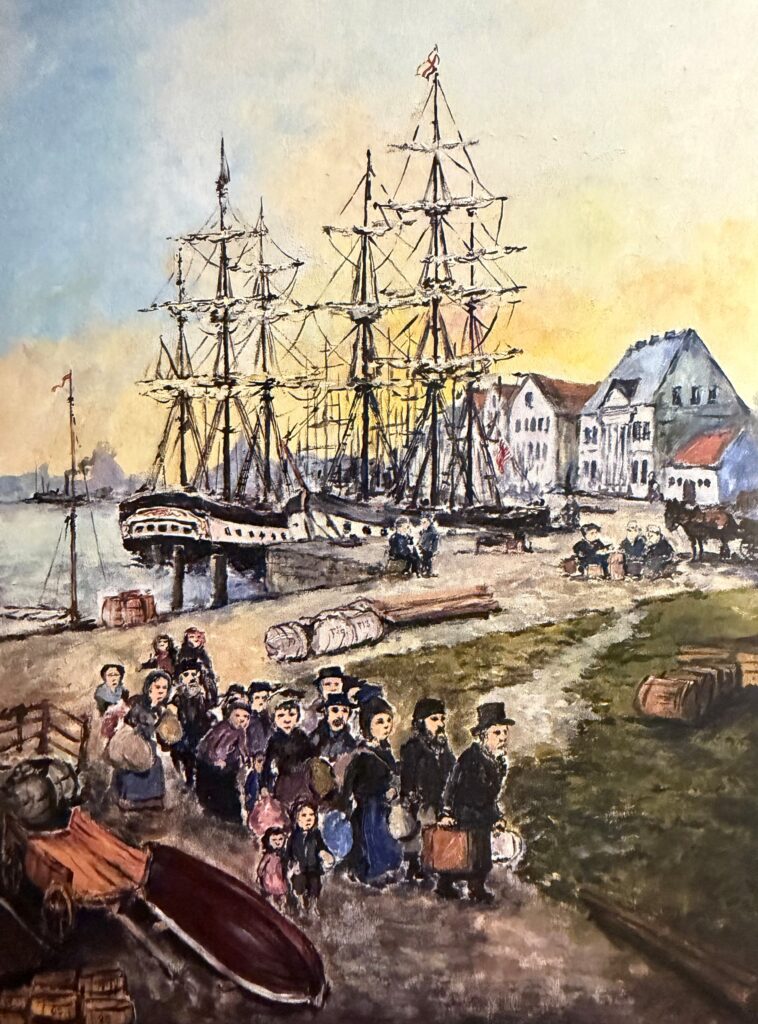
Already in the 1820s, impoverished Luxembourgers hoped to leave their homeland for greater economic opportunity elsewhere. The first noteworthy emigration occurred in the 1820s when Luxembourgers began leaving for Brazil which had just gained its independence from Portugal. They sold the little they had to pay for their tickets and purchase cheap land at their destination. Despite government warnings, many fell prey to corrupt and deceptive travel agents. One such group of about 100 would-be Luxembourg emigrants to Brazil made their way to the port of Bremen, Germany, in April 1828, to meet their departure ship for Brazil, but no ship arrived.
Although the Imperial Brazilian Consul Mr. Kalkmann, of Bremen, had announced in January 1828 that Brazil was no longer accepting emigrants, unsuspecting people had been persuaded to emigrate by deceitful emigration agents. These already poor people were swindled out of their money and returned home to Luxembourg filled with regret and shame. Some of the defrauded and impoverished groups had no money or place to settle in their former hometowns. Rather they created a “slum” settlement near the village of Grevels on a barren hill known as “Kahle Reis” or “Bald Rice.” The community was given the derogatory name of “Neu Brasilien” in German or “New Brazil.”[1] It remained a place of hardship and controversy for many decades.
Despite such challenges to emigration, ensuing years saw an uptick in emigration from Luxembourg especially to the United States. In the 100th anniversary booklet of the Derulle-Wigreux travel agency (1970), the author of the booklet writes:
The story of movement to North America makes much more cheerful reading. As we have seen, this was a traditional flow, but it did not become really marked until 1833, when two fair-sized parties left the old country. In 1845, large groups pulled out of the Préizerdaul[2] area, west of the capital, to settle in Illinois and were followed by a stream of their friends and relatives from the same region, increasing in numbers up to 1849. To this day Chicago has the largest Luxembourg-American community in the United States. With the growth of steamship travel, emigration grew too, faster and faster. In the four months April-August 1855 alone, some 2,000 Luxembourgers sailed, and the census of 1856, taken at a time when the whole of Europe was in the middle of a population explosion, actually shows a drop from 192,622 inhabitants of the Grand Duchy to 189,480. Emigration in the 1850s totaled an estimated 10,000, in the 1860s (when the volume was to some extent affected by the Civil War), 7,000, and in the 1870s, again 10,000. At the turn of the century there were something like 75,000 Luxembourg-descended families in the United States.[3]
Although 19th century Luxembourg was a pervasively poor country, government officials did not see emigration out of the country as something positive for the Grand Duchy nor did they look favorably at emigration agents. The author of Derulle-Wigreux’s 100th anniversary booklet wrote:
Officialdom, as usual, damned the emigration agents and their work as tending not only to depopulate but economically to impoverish the country. To publicize the loss involved, a practice was made of including in the statistics, in addition to the actual number of people leaving, an estimate of their property value. Thus, the figures for a fairly typical year, 1868, show that the 751 emigrants were reckoned to be worth 454,275 francs among them…The Luxembourg government of the time can hardly be blamed for feeling that this flight of capital, year after year, was more than a small, far from affluent country could afford.[4]
In addition, the government was concerned about how unregulated emigration agents often took advantage of unsuspecting emigrants as experienced decades earlier during the “Brazilomania” period of emigration. While there was little recourse to stop Luxembourgers from emigrating, it became obvious that regulations were needed for emigration agents:
…By this stage, a “keep-em-down-on-the-farm” emigration policy was simply not a practical proposition, and some forward-looking people were facing the facts, accepting the “evil” [the reality of emigration] and passing an Act of Parliament to lay down regulations for the running of agencies, so that at least certain blatant abuses could be checked. A draft to this effect was submitted in 1858 for the comments of the two highest legal authorities in the country (roughly, the Attorney-General and the Solicitor-General). Both came down heavily against it, on the grounds that such legislation, by conferring recognition on the agents’ activities, would encourage emigration still more. Nevertheless, the day came – not because the government had been converted – but because Luxembourg’s two larger neighbors, France and Belgium, had bowed to the inevitable and it was clearly absurd not to keep in step. The Emigration Agencies Rules of Operation Bill was debated in 1869 and became law on 13 March 1870.[5]
The Derulle emigration agency era begins
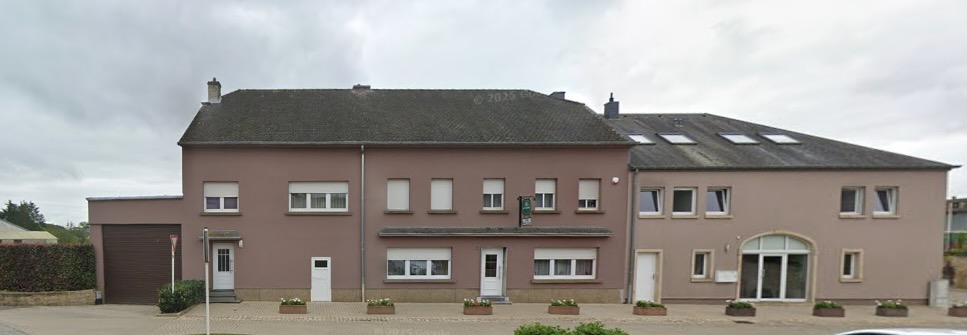
The pre-eminent emigration agents of the second half of the 19th century were Jean-Joseph Derulle and his son Emile Derule. Jean-Joseph Derulle was born on January 15, 1819, in Houdremont, Belgium, about 55 miles west of Luxembourg. When he was a child, his parents moved to Grevenmacher, Luxembourg, where his father took a job as a tax inspector.[6] On May 17, 1848, Jean-Joseph married Marie-Francoise Wigreux (aka Vigreux) in Kehlen, Luxembourg. She was born in Altweis, Luxembourg, on August 14, 1828, where her family had operated a hotel. Following their marriage in Kehlen, Jean-Joseph and Marie-Francoise settled in nearby Nospelt, Luxembourg, where they operated a hotel. The hotel was in the center of Nospelt next to St. Thomas Church. The building has been remodeled extensively over the years but remains standing (2026) at 2, CR104-A. It is currently a residence and the Café Muller-Feyder.
The Derulle 100th anniversary booklet states:
…Now Nospelt is in the region of western Luxembourg called the Pratzertal, from which, as we have seen, particularly large numbers of people were leaving just about this time for the United States. The Derulle-Wigreux village inn saw a constant coming and going of intended emigrants, busily discussing their plans with one another, with fellow patrons, and naturally, with the friendly landlord. Jean-Joseph quickly became an expert on the subject, and before long was offering help to the inexperienced in making their arrangements. And so, as the years went by, he came to work pretty much full-time as an emigration agent – unofficial, of course, for all such activities were then still unofficial, but a new and every way more desirable type of agent. Not the wandering mountebank enticing hapless innocents with promises of El Dorado, but the responsible confidant advising and looking after people who had already, upon thoughtful consideration, taken their decision to move.
Everything was done with Jean-Joseph in the proper form. Firm contracts were concluded between agent and emigrant, covering the journey to the port of embarkation as well as the actual crossing, including all necessary guarantees as to board, welfare and passenger safety, with a fixed scale of charges. Arrangements of this kind could, of course, only be made from Luxembourg in close co-operation with the big shipping companies.
Jean-Joseph duly established his network of contacts. His principal business connection was with Van der Becke & Marsily, the Antwerp agents of the Red Star Line. The majority of Luxembourg emigrants traveled Red Star Line, this having the advantage that the vessels sailed direct between Antwerp and New York, without the usual wearisome stopovers at Hull or Liverpool [England].[7]
Derulle’s emigration agency quickly grew and in 1863, he moved his family and his business to Luxembourg City to a building with a residence, modest hotel and restaurant. The building, located on the corner of rue Notre-Dame and rue Philippe II, near Luxembourg City’s cathedral, dated to the 17th century and had been a successful inn for many years. Derulle purchased the building from the estate of Joseph-Alexander Neu and name it “Auberge Au Lion d’Or, Derulle-Wigreux,”[8] in English, “Gold Lion Inn, Derulle-Wigreux.”

This new venture became Luxembourg’s first full-scale emigration agency at the same time offering board and lodging facilities for emigrants. The Derulle building was located almost next door to the Hôtel des Boulevards, which frequently accommodated any overflow of emigrants from Derulle’s hotel.
In March of 1870, the Luxembourg government implemented its new and strict law requiring all emigration agents to be licensed. Derulle, who had achieved a positive reputation as an agent and who by this time had a monopoly on emigrant services, immediately applied for his license. According to the Derulle-Wigreux 100th anniversary booklet:
…On 10 May 1870, the Commissioner of Police sent in a report stating that the applicant [Derulle] was in every way a fit and proper person as the manager of an emigration agency, more particularly in the important respect of having an exemplary record as law-abiding, solvent and of good moral repute. He added the positive tribute that “Mr. Derulle has been operating as an emigration agent for years and has made all arrangements on behalf of a large number of emigrants, from none of whom has there ever been the smallest complaint that the terms of the contract were not adhered to.”[9]
Just nine days later, May 19, 1870, Derulle became a state-approved emigration agent. His business continued to flourish and grow. He continued to lead the business until his death on December 12, 1881, at age 62.
[1] “Die Entstehungsgeschichte von Grevels (The Original Story of Grevels), undated pamphlet from St. Donatus Church in Grevels, Luxembourg in German, unpaginated.
[2] Author’s note – Préizerdaul is a municipality of Luxembourg. The name also refers to the surrounding area in the west of Luxembourg in the Canton of Redange including the villages of Bettborn, Pratz, Reimberg and others. In Luxembourgish the word “dall” means valley, so Préizerdaul can be understood as the valley of the Préiz.
[3] Derulle-Wigreux & Fil – Emile Weitzel, successeur, Centenaire 1870-1970, Imprimerie Saint-Paul S.A., Luxembourg, 45.
[4] Ibid., 46.
[5] Ibid., 47.
[6] Ibid., 48.
[7] Ibid., 48.
[8] Ibid., 48.
[9] www.industrie.lu/Derulle-Wigreux.html.
0 Comments