
“Desertion” by Chantal Lorang
This webinar will take place Saturday, February 20th, 2027 at 1pm CST
Make sure to subscribe to hear when registration opens!

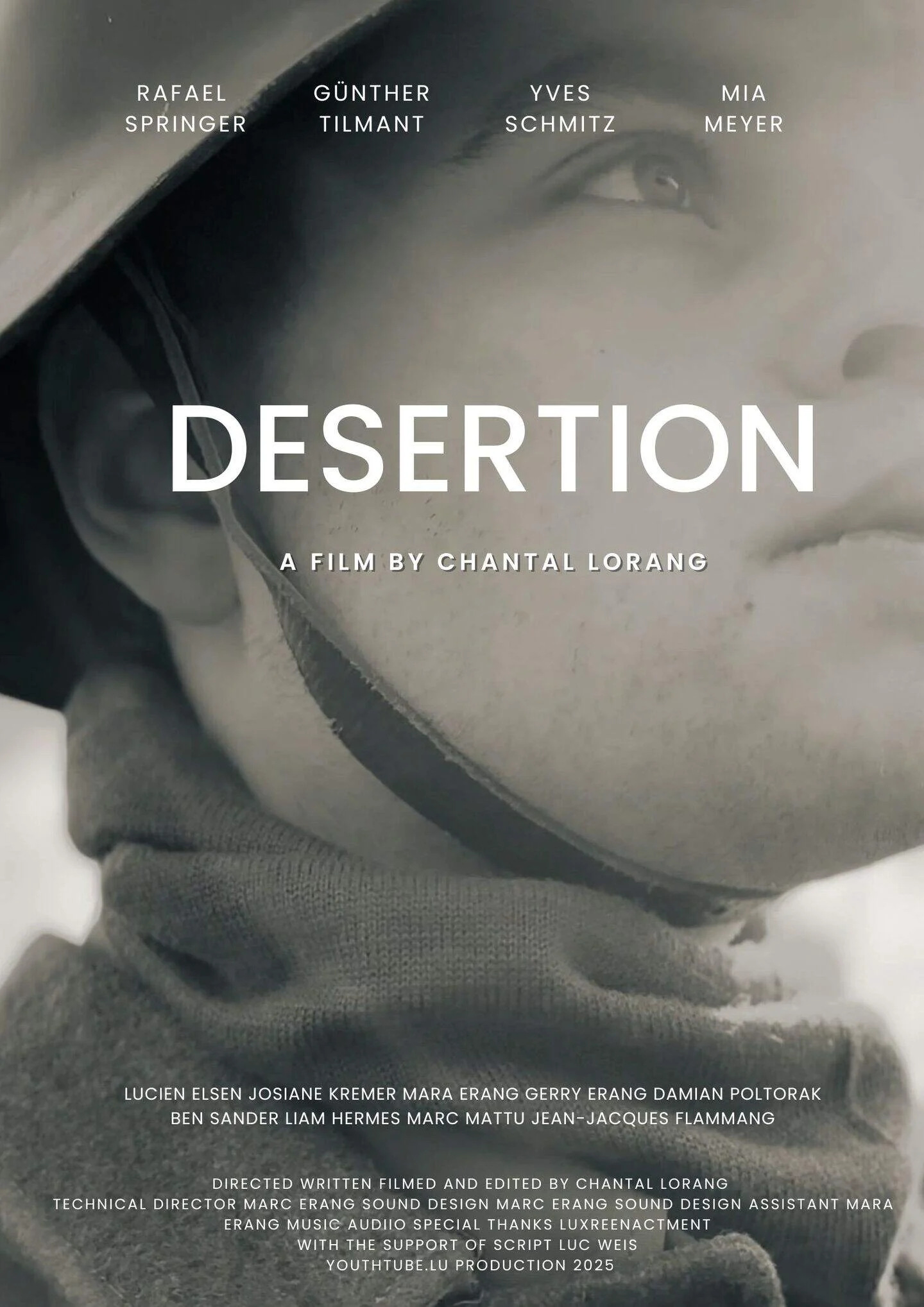
U.S. Premiere of Desertion by Luxembourger Chantal Lorang
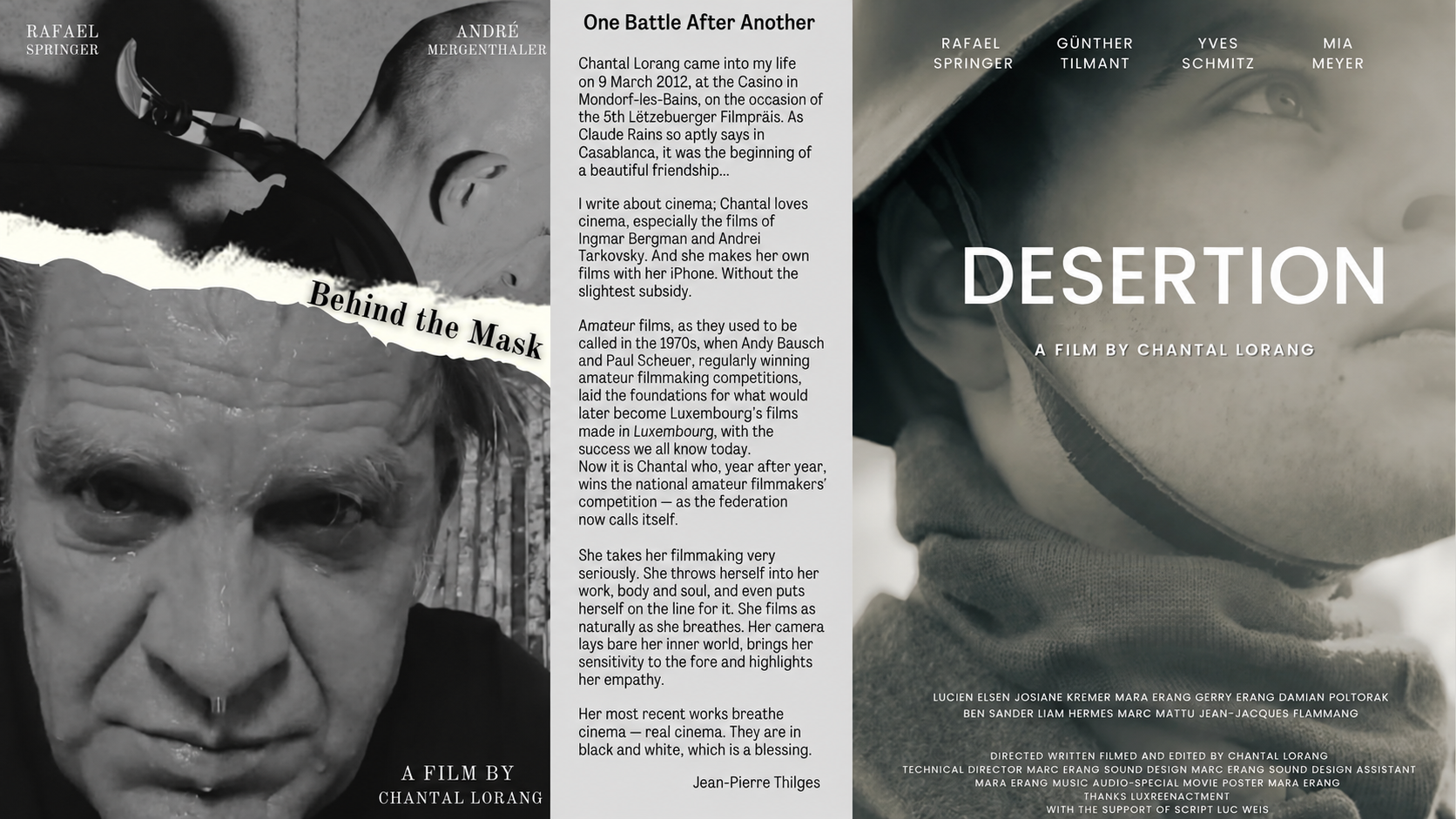
Read a LuxTimes article about Chantal and her film.
Luxembourg Legacy is proud to present the U.S. premiere of Desertion, an award-winning short film by Chantal Lorang, of Heisdorf, Luxembourg.
The 30-minute film, written, filmed and edited by Chantal, tells the tragic story of her great uncle Josy Lorang, who was forcibly conscripted into the Nazi army during WWII. Shot on her iPhone without official funding, Chantal’s Desertion won best film award and first prize in the fiction category at the National Film Festival of Luxembourg in 2025 and a silver medal and jury prize at the international 2026 UNICA Film Festival.
UNICA Film Festival jury member Thomas Schauer wrote:
“Through outstanding photography and editing, this film creates an atmosphere that makes the cruelty of war impossible to look away from. It does not simply show violence; it brings back the memory of all the atrocities that war carries with it. This is a film that should be shown to every generation, so that we never allow ourselves to consider war again in our world.”
The horrors of war
As a young soldier in the German forces, Josy was sent to the Eastern Front, where he witnessed horrors that haunted him—the suffering of civilians, the brutality of war and the devastation left in its wake. Unable to bear what he had seen, Josy made the fateful decision to desert. He was captured by the Germans and imprisoned. In the film, a military chaplain remembers the young soldiers who ran away on the Eastern Front, including Josy, whom he looked after in prison. In the weeks before his execution, Josy wrote letters to his young wife Margot and to his parents, pouring out his fear, love and desperate hope.
When she was a child, Chantal read one of Josy’s letters as she sat at the kitchen table with her family. Years later, the letter-reading inspired Chantal to tell Josy’s story through film. Her goal was that the film will be used for educational purposes and serve as a reminder, especially to young people, of the trauma and human cost of war.
Chantal and her husband Marc Erang will join Luxembourg Legacy live from Luxembourg for this U.S. premiere of Desertion. They will share information and field questions after the film.
NOTE: This film portrays the atrocities of war and contains violence, sexual assault and brief nudity. Viewer discretion is advised.
Our Luxembourg Legacy Presents webinar is free of charge, but participants are asked to consider a free-will, tax-deductible donation to their local Luxembourg-American organization.
Make sure you are subscribed to our mailing list so you hear as soon as registration opens for this special event!

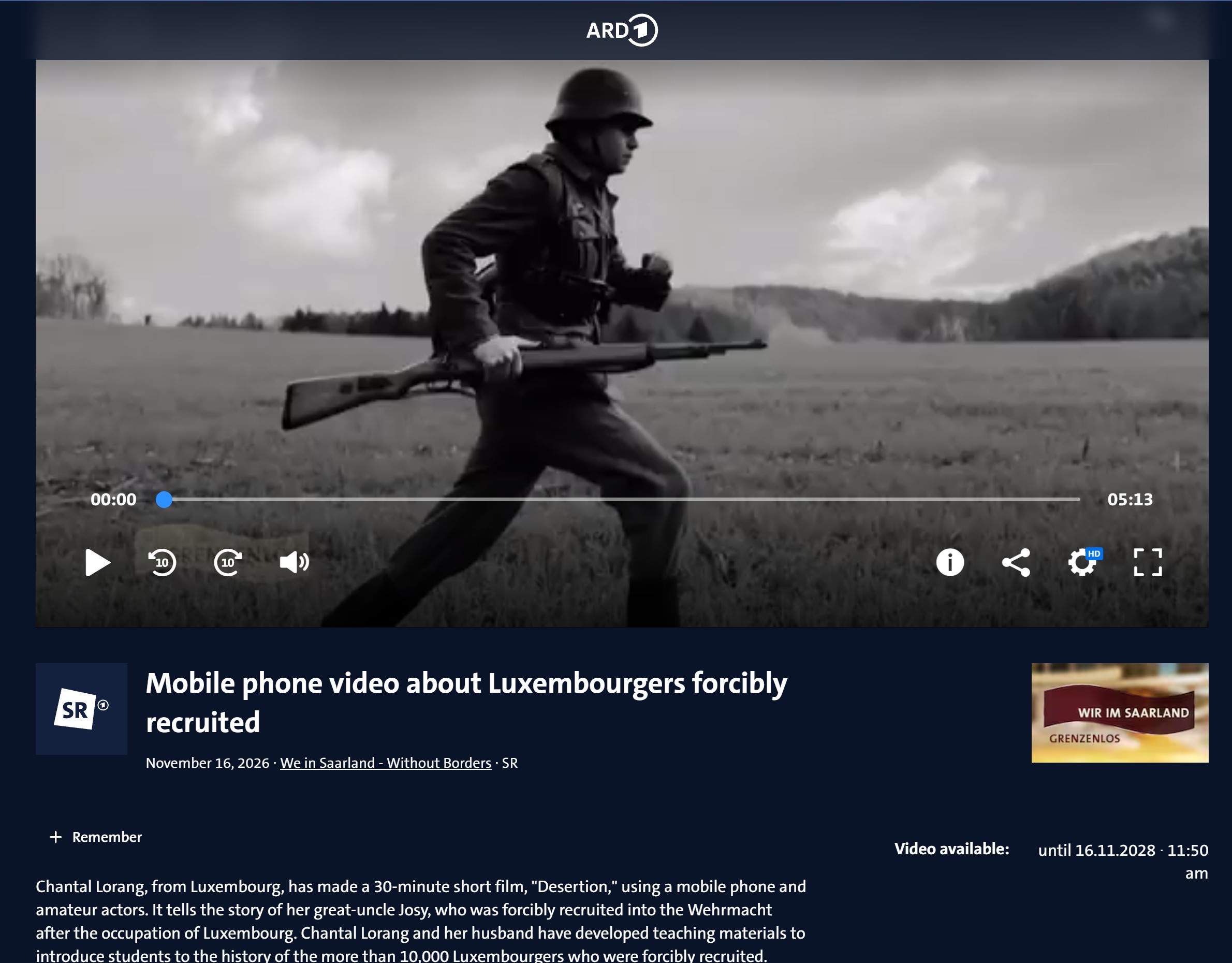
News clip about the film by ARD Media Library
See English translation below
English translation by Chantal:
It’s truly remarkable. Not so long ago, you had to carry around a good SLR camera to capture beautiful images; now, a mobile phone is all you need—you can even shoot entire films with one. A woman from Luxembourg has just produced a thirty-minute short film, which explores the fate of her great-uncle. It follows a young man running for his life after deserting from the Eastern Front during the Second World War. This is the story of Joseph Lorang—known as “Josie”—one of 10,211 Luxembourgers forcibly conscripted by the Wehrmacht during the occupation. Chantal Lorang, Josie’s great-niece, was so deeply moved by his story that she decided to bring it to the screen, using only a mobile phone and actors from a historical reenactment group. She spent two years working on the film—writing the script, scouting locations, and handling the editing herself—all without a single cent in film funding.
A teacher of German and media studies, she now works in a school library, though she continues to pursue film projects—both with her students and on her own.
Chantal Lorang: “While making the film, I had certain things planned, but I also left plenty of room for improvisation—for instance, when a bird flew into the room. As soon as it appeared, I captured it on camera—as a symbol of captivity, fear, and panic.”
Barely three weeks after his capture, Josie was executed near what was then Leningrad at the age of 22, leaving behind his new bride, Margot. Only a few traces remain—a photograph of Josie and Margot, perhaps, or his death notice. Norbert was five years old when his uncle died, but he still remembers.
Norbert Lorang:
“I came into the room after playing—I had been playing out in the garden.” The entire family sits around a table, weeping loudly. No one told me what had happened. They simply said that Josy had gone abroad with Margot, and that, in all likelihood, we would one day travel abroad to visit them. It was clear then: the family was being punished for desertion. They were forcibly resettled, and their transport business was confiscated. In Lower Silesia, the family lived in camps and was forced to perform hard labor—including work in a hotel. They were only able to return after the war ended. Some 1,400 families in Luxembourg faced a similar fate.
The film project is supported by the Ministry of Education, which granted Chantal Lorang partial leave from her teaching duties. The film is now available on the online platform *films4schools*. Together with her husband, Marc Erang—a teacher of comparative media studies—she developed accompanying educational materials. This fits perfectly into the concept, says the director of SCRIPT, the department responsible for providing learning resources.
Luc Weis:
The film is excellent for contexts that go beyond standard classroom instruction—transcending the traditional subject boundaries that remain very rigid in schools, where German class, history class, and ethics class are typically kept separate. Here, we have something that connects these three subjects, building a bridge between them. It is an innovative approach that also creates a link to direct engagement with contemporary witnesses—for instance, through visits to a retirement home in Luxembourg.
Marc Erang notes that this makes the subject matter much more tangible for students. Many had never heard of the forced conscription in Luxembourg before. Josy was one of 166 individuals who were executed. This film serves as a memorial to those in Luxembourg who were forcibly conscripted, as well as to those who fell or went missing during the war.
Student 1
The film was, without a doubt, very moving.
Student 2
It is deeply moving to see how devastating the war was for some people—and how Josie was forced to go to war, even though he never wanted to.
Student 3
This is something that should be part of the curriculum in every school. It is an essential component of civic education—a way to strengthen democracy by ensuring we understand our own history. We must remain aware of this so that it never happens again.
For Chantal, the project goes beyond mere history lessons or the process of coming to terms with personal trauma. It was important to her that the focus not be limited solely to her own family history. We live in an era of war—in places like Iran and Gaza. We wanted to highlight experiences that are universal, by showing the families—the mothers and the widows—whose lives were completely shattered.
These images etch themselves so deeply into our hearts that, under their weight, we are left speechless.
Want to learn more?
Mark your calendar for our other upcoming webinars!