
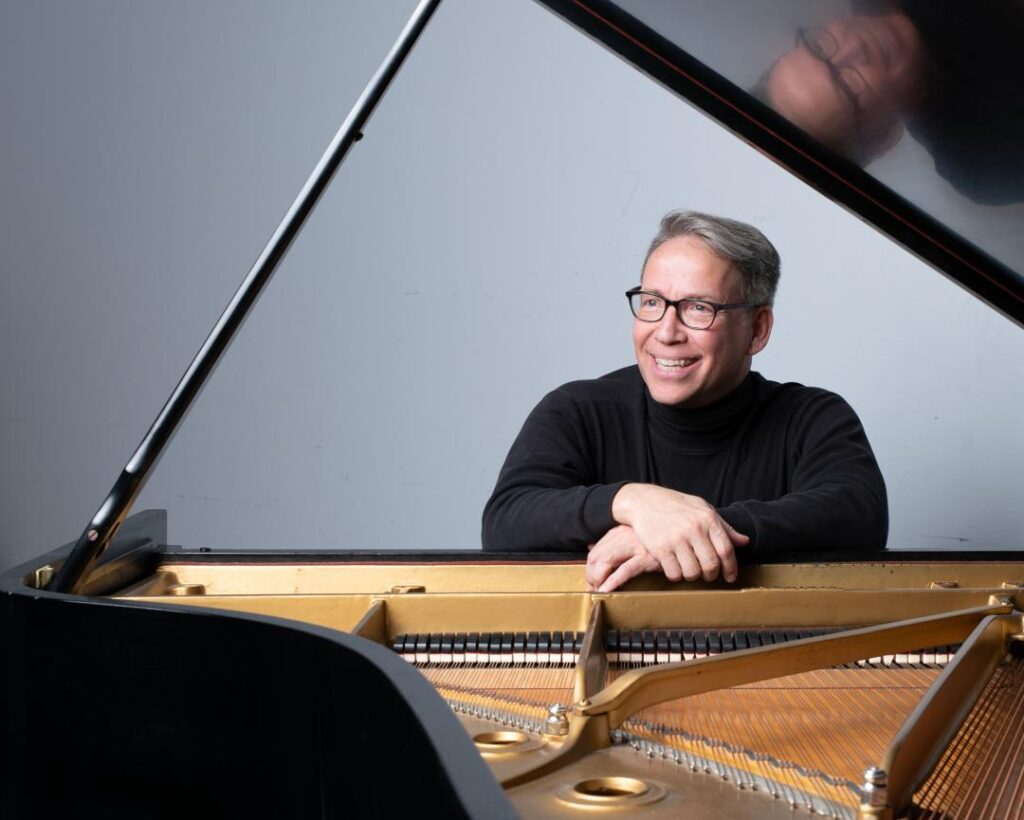
This article is eighth in our series on Luxembourg Americans who have gone through the process of reclamation of Luxembourg nationality to become Luxembourg citizens. These dual citizens, who were assisted in their citizenship journey by Luxembourg Legacy, reflect the passion that new Luxembourgers in America have for all things Luxembourg. This month, we’re featuring Gerald “Jerry” Steichen, an American conductor, pianist and actor, who is from Tonkawa, Oklahoma, and has roots in Koerich, Luxembourg—a small-town boy who made it big!
By Mary Bolich
One of America’s most versatile conductors, Maestro Gerald Steichen’s career has ranged from symphonic programs to operatic performances, Broadway shows to chamber music recitals, with a biography peppered with prestigious symphonies, elite opera companies and mega-musicals. But when he talks about his life, Jerry’s focus is on family.
“We’ve always been a very close family, which is such a blessing,” said Jerry, the fifth of Robert and Margaret (Beadle) Steichen’s six children. “I moved to New York City when I was 25, which is what I always wanted to do for my career in music, but I flew home five or six times a year because I didn’t want to miss important family events like birthdays and holidays.”
Born in the small town of Tonkawa in north central Oklahoma, Jerry was raised in a very musical, community-engaged, Catholic and weekend-farming household.
“Daddy was a high school band director—he played the trombone— so we all played piano, sang in choir and played an instrument in the band. Mom and Dad were wonderful dancers, so that was also part of growing up Steichen. We were very involved in the Catholic church. I started playing the organ for Saturday night Mass when I was 13, before I could reach the pedals. We lived in town, but we farmed on the weekends, so we grew up driving combines and tractors in the summer. My parents were always very supportive of all six of us and came to every show I ever did and events my siblings took part in. They were amazing people and remarkable parents.”
Jerry’s parents loved to travel, and they shared that love with their children. After all the kids had left home, the family took big trips together with spouses and children in tow.
“Every two years, we would plan an adventure—an Alaskan cruise or a beach house in Pensacola, Florida, and later a 17th century farmhouse in Chianti and three stunning houses overlooking the Pacific in Costa Rica. When we went to Hawaii., we had our own private luau in Hawaii because with 45 of us, it was cheaper to bring the party to us, including our own fire dancer cooking the pig buried on our own piece of beach,” Jerry said. “Those trips were really special—creating all those memories with Mom and Dad and the entire family.”
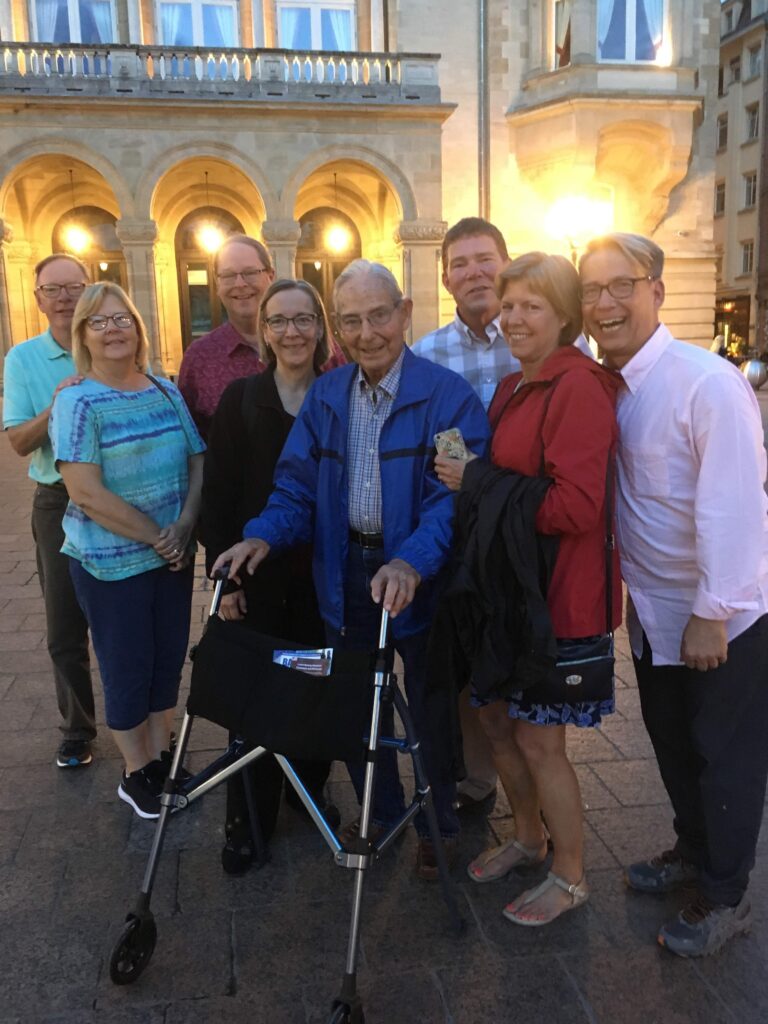
Jerry’s mother passed away in 2018, but the family made one more trip before his father died in 2021 to Luxembourg. Inspired by their cousins, Jerry and his siblings visited the Grand Duchy in 2019 to apply for Luxembourg citizenship.
A musical journey through life
When Jerry was about seven years old, he sat under the podium coloring as his father conducted the band at Northern Oklahoma College. When his father stopped to give somebody a correction, Jerry piped up and announced that the third trumpet player was flat. And he was right.
“I just got blessed with really good ears,” Jerry said.
Along with piano and organ and singing, Jerry played the clarinet. When he was a sophomore, his high school band director handed him a bassoon before Christmas break and told him to “figure it out.”
“I fell in love with the bassoon. It just made sense to me, and I’ve always thought instruments choose people; not the other way around. Two months later, there were auditions for the All-Region Orchestra. I had never played in an orchestra before, but I was named first chair. I had no idea where the bassoons sat in an orchestra, and when they handed out the music, I didn’t even know the fingerings for many of the notes.”
Due to their father’s position as a teacher and guidance counselor at Northern Oklahoma College (NOC), all the Steichen children attended college there.
“We called ourselves ‘faculty brats’ because we basically grew up on campus and we lovingly nicknamed NOC ‘No Other Choice.’ Junior colleges are just wonderful: to take those first two years of required courses someplace smaller and cheaper. And NOC was great not only because it had rigorous academics, but it also had a very active music and theatre program. The show choir, the Roustabouts, actually went to Russia and Romania for three weeks the year I was a student there,” Jerry said.
Jerry’s musical talent earned him a full scholarship to Oklahoma City University.
“I got a full bassoon scholarship not because I played so well, but because I doubled on baritone sax and the tuba player never show up for pep band at the basketball games,” Jerry said with a laugh.
While pursuing his master’s degree in accompanying at the University of Southern California (USC), Jerry “played tons of voice and instrumental lessons, recitals and master classes, opera rehearsals and choral conducting seminars. His opera conductor and advisor encouraged him to audition for the Merola Opera Program, the renowned summer training initiative affiliated with the San Francisco Opera. Only 20-23 singers and 4-5 pianists from around the world are selected for the prestigious program.
“I thought, ‘They’re never going to hire me, a 25-year-old musical theatre kid from Tonkawa, Oklahoma, who has literally only played four entire operas from beginning to end.’ But I drove up to San Francisco, and my audition lasted for almost an hour. I played my excerpts, translated, sightread and conducted a bit. About a month later, I got home from school and there were two messages on my machine: one from Music Theater of Wichita, Kansas, where I had been the assistant conductor for three summers, asking me to conduct the entire season, and the second one from San Francisco asking me to participate in the Merola program.”
He chose the “road less traveled” and moved to San Francisco for the summer. Following his Merola experience, Jerry was asked to join the Western Opera Theatre company, the touring arm of the San Francisco Opera, as assistant conductor and pianist for a national tour of “Madame Butterfly.” Then, USC called and encouraged him to complete his master’s degree, which he was able to do by attending the Music Academy of the West in Santa Barbara, California. In the evening after classes, he drove to Los Angeles to play rehearsals for the LA Music Center Opera productions of “Tosca” with Plácido Domingo conducting and Kurt Weill’s singspiel “Mahagonny.”
It was at this time that Jerry, the only one of his musically inclined family to consider a career in music, began to have doubts about his life’s direction.
“I knew I loved making music more than anything, but I thought, ‘How do you make a living doing this and still love it?’ So, I stopped playing for a year and moved to Miami to learn about the business of making music.”
He worked as the artistic administrator of the Greater Miami Opera, responsible for negotiating contracts with singers and artist agents, scheduling rehearsal calls, overseeing artist housing and transportation, writing and calling supertitles, coordinating young artist performances—learning the nuts and bolts of the music industry. He quickly realized that, though important, being an administrator was not his calling, so he moved to New York City with just a suitcase and $200. He had made numerous connections with agents and singers, so he called them inquiring about auditions, coachings, positions and openings.
“The thing about being from a small town is that no one tells you can’t do something. No one says, ‘You can’t move to New York City and make a living as a musician.’ So, I got to New York with what turned out to be the right combination of skills and knowing or meeting the right people. And also, being really lucky. I always tell people the secret of my career was to say yes to every job offer, and then figure it out as you go along,” Jerry said. “And I also played really well,” he added.
Throughout his illustrious career, Jerry served as music director of the Ridgefield Symphony (Connecticut) and was principal pops conductor of the Utah Symphony for 12 seasons and for 15 seasons with the New Haven Symphony Orchestra. He worked with the New York City Opera for 10 seasons, leading performances including “La bohéme,” “L’elisir d’amore,” “Dead Man Walking,” “The Little Prince,” “The Mikado,” “The Pirates of Penzance” and “Cinderella.” He played piano on stage for the New York City Opera’s acclaimed productions of “Porgy and Bess” and “Carmina Burana” and conducted opera companies across the country.
A frequent guest conductor for the Boston Pops and the New Jersey Symphony, Jerry has appeared with symphonies throughout the United States and internationally and toured nationally as the conductor of the Lincoln Center production of “The King & I,” associate conductor of “The Phantom of the Opera,” “The Secret Garden” and “Peter Pan” and conducted the original production “Cats” in New York for its final two years. Jerry also appeared on Broadway portraying Manny, the Accompanist in the Tony Award-winning “Master Class” starring Dixie Carter, and he performs instrumental and vocal chamber music recitals internationally.
“My whole life I’ve been a very, very lucky, blessed man. I came from a little town of 3,000 people in the middle of nowhere, moved to New York City, earned enough to purchase an apartment on the Upper West Side, and made a life in music and theater. I get to work with incredibly talented, wonderful colleagues. I still can’t walk down the street without running into someone I know or have worked with. And that’s pretty remarkable, isn’t it?”
With all the professional achievements and international fame, Jerry is anchored by his small-town roots.
I get to go home to Tonkawa, where there are few sirens, two streetlights and the pace is a bit less frantic. You can see the stars and hear the grass grow. It’s peaceful and that’s pretty wonderful,” Jerry said.
Q & A with Jerry
Were you aware of your Luxembourgish roots/heritage growing up?
Mom is over half Luxembourgish and Daddy is 100 percent Luxembourgish. So, we are kind of the map of Luxembourg. In fact, I laughed when we opened the phone book in Luxembourg, and there are literally pages of Steichens. It’s like the “Smith” of Luxembourg. We had known that we were Luxembourgish, because we’re all kind of interested in that. Daddy definitely wanted to go before he died. And then, of course, there’s Edward Steichen, the world’s most famous Luxembourger. His third wife Joanne lived in New York City, and we became great friends before she died. She was a huge opera fan, and we used to get each other’s emails: JSteichen.
Why did you apply for dual citizenship and what does it mean to you?
Several of our cousins had gone two years before and gotten their dual citizenship, and we all thought that was pretty cool. So, we kind of just retraced their steps tracing our heritage. The Luxembourg passport also allows me to work in the EU, and not to get too political, it gives us multiple options for places to live in the world.
What was your impression of Luxembourg and your favorite experience, sight, outing or memory about it? Luxembourg City is such a jewel. We also stayed in the north at an agri-tourist place in the middle of the countryside, which my niece-in-law found. We felt very comfortable there. The big thing I remember about our trip was visiting Koerich, our historical family home. I got to play the organ there. Later, I needed to use the bathroom, and Luxembourgers are quite private about their homes, but they were so charmed by my playing that they actually invited me into their home. Just the warmth of the people, again, is so surprising. That was a beautiful day. Another great memory was going to the American Cemetery where Patton is buried. My dad was a veteran, and we just happened to be there at 5 o’clock so the gentleman who gave us the tour of the cemetery asked my father if he would like to participate in the flag lowering, so my dad and my niece Madeline lowered the flag over the American cemetery, and that was just such a spectacular day.
Describe your experience working with Luxembourg Legacy in the dual citizenship process.
Oh my gosh, Kevin made it completely effortless. He was so detail-oriented and accommodating. I have not yet met Kevin in person, but we’ve had so many conversations on the phone and via email, I just feel like I know him.

WOW, what a career and great story….remember the Steichen name from our 2015 Luxembourg trip; altho, as I recall, that they were sisters from Iowa
As a musician, I loved reading this article about Jerry.